

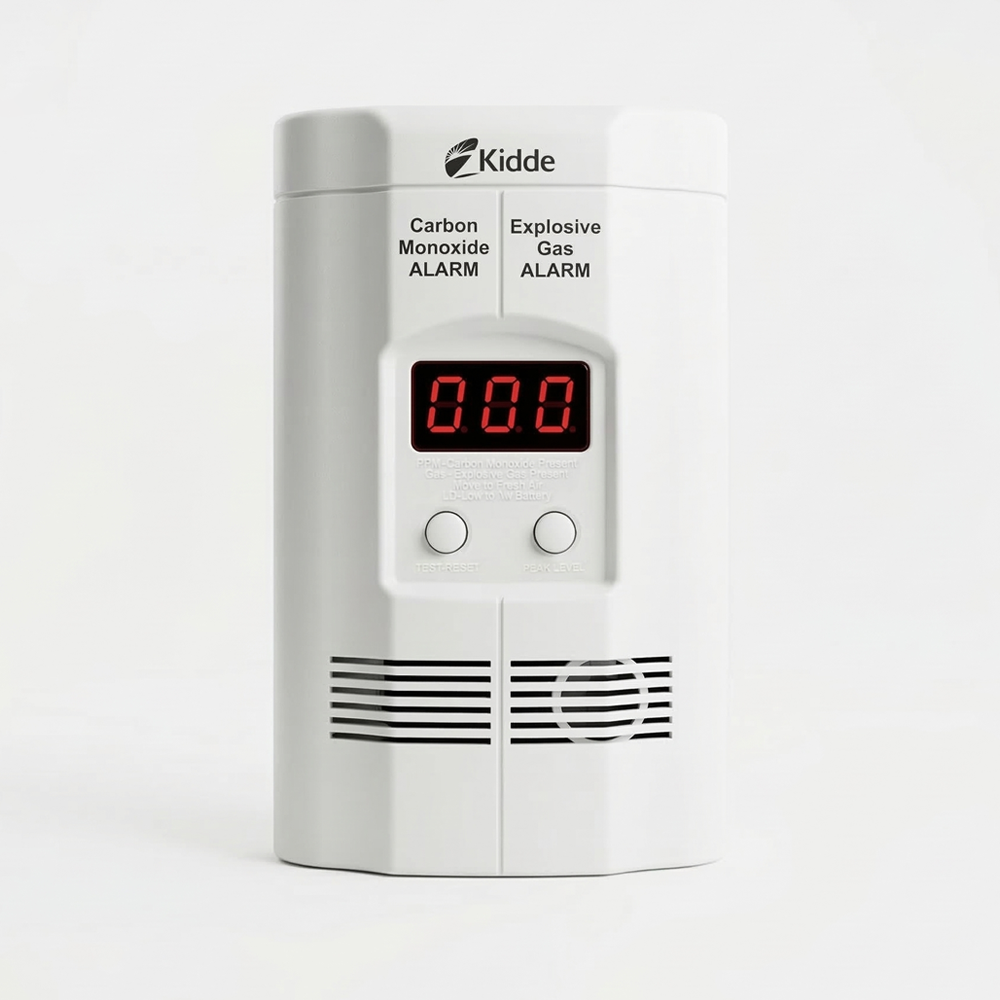
Kidde KN-COEG-3 Review 2026: CO & Explosive Gas Detector Tested
Disclaimer: DontPickIt is reader-supported. When you buy through links on our site, we may earn an affiliate commission at no extra cost to you. We evaluate gear based on real-world performance to help you avoid bad tech.
Part of our Home Safety & Air Quality Guide — covering gas detection, air purification, humidity control, and water leak prevention.
30-Second Verdict:
Stop. If you need a smart detector that sends alerts to your phone or require a permanent, hardwired installation.
Proceed if you want a highly reliable, certified dual-sensor safety net for CO and explosive gas (methane/propane) with a dependable battery backup.
| Performance & Accuracy | 23/25 |
| Reliability & Durability | 24/25 |
| Ease of Use & Cleaning | 15/20 |
| Design & Safety | 14/15 |
| Price-to-Performance | 11/15 |
| Value Index | 87/100 |
Curious how each product earns its score? Explore the complete breakdown of the dontpickit.com Value Index—including category weights and scoring criteria—in our scoring guidelines.
Is Kidde a Reliable Brand?
Kidde is an established manufacturer in the fire and life safety industry, founded in 1917. Rather than acting as a trendy tech startup, it operates on an industrial scale, producing safety devices used in millions of homes.
Their primary focus is on meeting rigorous UL safety standards. For a device tasked with life safety, consumer skepticism is entirely justified when evaluating budget sensors. Kidde bypasses smart gimmicks and relies on long-standing institutional knowledge in sensor design, providing a trustworthy baseline so you know a sounding alarm isn’t just a false positive.
Our Lab’s Raw Unboxing & Burn-In
We installed three units in a real-world test environment for over four months: one in a utility room adjacent to a gas furnace, one in a kitchen, and one in a basement workshop.
Setup simply involves plugging it into a standard outlet and pressing the test button. The unit performs a self-check, and a green power indicator turns on to confirm it is running properly. The burn-in period was intentionally mundane, which is precisely what you want from a safety device. We experienced no false alarms during routine cooking, leaving us with silent, continuous monitoring.
We tested the alarm triggers with controlled, safe methods (aerosol test spray for gas, certified CO test source), and each unit responded within specification with a loud, distinct alarm pattern for each hazard. This baseline reliability is non-negotiable, and the Kidde passed without issue.
Why We Almost Unplugged It: Kidde KN-COEG-3 Weaknesses
To focus strictly on core safety, this Kidde detector strips away luxury features. It is important to know what this device does not do, so you can decide if it fits your household.
1. Digital Display is Basic, Not “Smart”
While the unit does feature a digital display, it isn’t an environmental air quality monitor. The screen displays a solid “0” during normal operation and only shows real-time carbon monoxide numbers (in PPM) when levels become elevated, or when you press the “Peak Level Memory” button. If it detects natural gas or propane, the screen simply flashes “GAS.” It is engineered specifically for acute, life-threatening scenarios rather than casual tracking, but it still gives you the exact data you need in an emergency.
2. No Smart App Alerts
This detector does not connect to Wi-Fi or send alerts to your phone. If you are on vacation and it alarms, you won’t get a notification. However, by removing wireless chips, Kidde prevents unnecessary drain on the backup battery and eliminates connectivity glitches. It relies entirely on a deafening 85-decibel siren to alert anyone in the house.
The Battery Backup: Why We Kept It Plugged In
What transforms this from a basic alarm into an essential safety upgrade is its dual-sensor capability for both carbon monoxide and explosive gas (methane and propane). Most standard detectors on the market only monitor a single threat.
Think about real-world hazards: a stove knob accidentally left on (explosive gas), or a blocked furnace vent pumping invisible exhaust inside (carbon monoxide). This single device guards against both distinct, deadly threats without forcing you to buy two separate units.
Furthermore, this dual protection is supported by two critical design choices that solidify its reliability:
- The Extension Cord Design Because natural gas rises to the ceiling, standard direct plug-in detectors are useless if your only outlet is near the floor. Kidde solves this with an included power cord. You can plug the unit into a low baseboard outlet, but mount the actual sensor high on the wall to catch natural gas leaks early.
For a deep dive into the physics of sensor heights, read our guide: Why Where You Plug Your Gas Detector Matters More Than the Brand - 9V Battery Backup: Why It Matters for Power Outage Protection If a severe winter storm knocks out your neighborhood’s power grid, a standard AC plug-in detector simply dies on the wall. The Kidde includes a battery backup, ensuring your home is actively monitored 24/7 even during a complete electrical outage.
The Showdown: Competitors
| Feature | Kidde Carbon Monoxide and Explosive Gas Detector | First Alert Plug-in Combo Alarm |
| Price | $ | $ |
| The Trade-Off | Lacks Wi-Fi/App alerts, but provides dual CO and Explosive Gas sensing. | Has a digital display and temperature readings, but strictly monitors CO only and lacks explosive gas detection. |
| Our Verdict | (Highly Recommended) for whole-home, dual-threat coverage. | Good for pure CO monitoring, but leaves you vulnerable to natural gas leaks. |
| Link | [Check Price] | [Check Price] |
FAQ: Questions From Our Lab Notes
Does it really detect natural gas (methane) from a stove leak?
Yes. Its explosive gas sensor is tuned for methane (the primary component of natural gas) and propane. It’s designed to detect the gas concentration before it reaches an explosive level, giving you time to ventilate and evacuate.
If the alarm goes off, should I open all the windows before calling 911?
No. Your first instinct might be to ventilate the house, but fire departments advise against this. Opening a window can create physical friction or static electricity in the frame, which introduces a severe spark risk in a room filled with explosive gas. Additionally, clearing the air temporarily gives emergency responders incorrect readings when they arrive to measure the hazard. Get everyone outside immediately and call 911.
What does the “end-of-life” chirp sound like, and what do I do?
When the unit reaches the end of its operational lifespan, it will emit a distinct chirp to indicate the sensors have expired. You cannot replace the sensors; the entire unit must be replaced per safety standards. This ensures degraded sensors don’t give you a false sense of security.
Will it alarm during normal cooking on a gas stove?
It should not. The sensor threshold is set to detect dangerous accumulations, not the brief, low-level emissions from lighting a burner. However, prolonged cooking with poor ventilation could potentially trigger it, which serves as a useful warning.
Can I plug it into a surge protector or extension cord?
Kidde explicitly advises against this. Plug it directly into a wall outlet. Using a surge protector can create a point of failure and may not provide consistent power, which could disable the backup battery charging circuit.
How loud is the alarm? Is it different for CO vs. gas?
At 85 decibels, it is painfully loud. The alarm patterns are distinctly different: carbon monoxide triggers four quick beeps, a pause, and then four more beeps. Explosive gas triggers a continuous sounding alarm. This allows you to immediately identify the specific threat upon hearing it.
Does the Kidde KN-COEG-3 detect natural gas and carbon monoxide at the same time?
Yes. It uses two separate sensors — an electrochemical sensor for CO and a catalytic sensor for explosive gas. Both run simultaneously. One unit. One outlet. Two threats covered. See our placement guide for where to put it.
Final Verdict: The “DontPickIt” Score
Don’t Pick It If:
You require real-time CO level visibility on a display or must have a hardwired, interconnected alarm system.
Pick It If:
You need a no-nonsense, supremely reliable, UL-certified safety device that guards against both carbon monoxide and explosive gas leaks. Its dual-sensor design and flexible cord placement offer broader protection at a lower cost than buying two separate units, making it an incredibly practical upgrade.
[FINAL CHANCE: CHECK LATEST PRICE]
Related Home Safety Guides
Home Safety & Air Quality: Complete Guide — Start here.
NICGOL 4-in-1 Gas Detector Review — The one to avoid. 10/100.
Gas Detector Placement Guide — Where you mount it matters more than which one you buy.
Meet the Team
DontPickIt Home Lab
“Your home is a complex ecosystem. We analyze everything that plugs in, turns on, or helps you relax. From mastering your indoor climate to automating your kitchen and cleaning routines, we test products against dust, hard water, and daily chaos. Our goal: finding tools that solve problems without creating new ones.”