

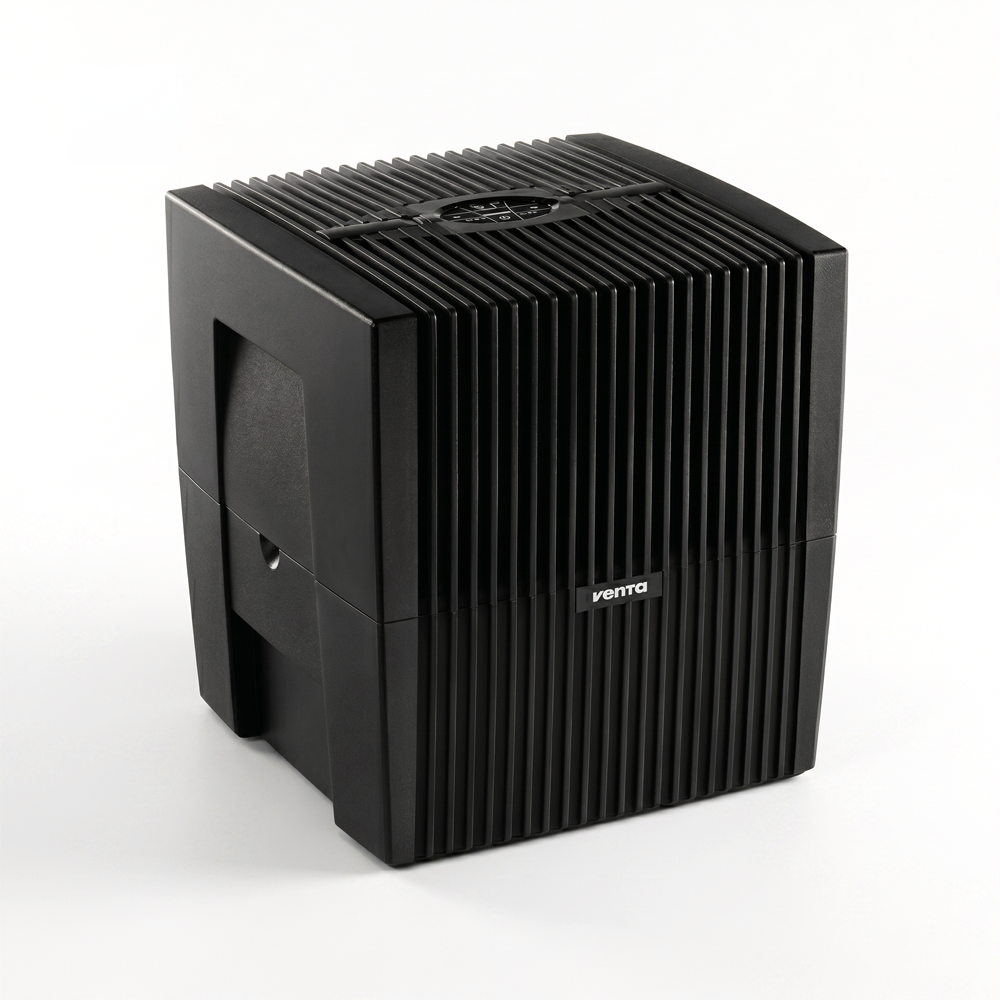
Ultrasonic vs Evaporative Humidifiers Guide (2026): Which Is Safer?
Disclaimer: DontPickIt is reader-supported. When you buy through links on our site, we may earn an affiliate commission at no extra cost to you. We evaluate gear based on real-world performance to help you avoid bad tech.
Part of our Home Safety & Air Quality Guide — a complete roadmap to protecting every room in your home. Covers humidifiers, air purifiers, gas detectors, and water leak sensors.
You bought a humidifier to help you breathe easier. But there is a critical design flaw in most popular humidifiers: they are often delivery systems for bacteria and “white dust.” Here is the uncomfortable truth: If you can see the mist, you are likely breathing dirty air.
As engineers, we don’t care about colorful night lights. We care about air quality mechanics. This guide will explain why cheap ultrasonic humidifiers are risky, and why we (almost) exclusively recommend evaporative technology for a healthy home.
Note: Confused about the difference between Humidifiers, Dehumidifiers, and Air Purifiers? Start here with our master breakdown: Humidifier vs Dehumidifier vs Air Purifier — How to Choose the Right One
The Science of “White Dust” – Mist vs. Vapor
To understand why some humidifiers leave white dust and others don’t, we have to look at how the water gets into the air. There are three ways to do this, but they produce two very different results: Mist (Liquid) and Vapor (Gas).
1. Ultrasonic Humidifiers (Atomization)
This is the technology found in 90% of the cheap “cool mist” humidifiers on Amazon. It uses a ceramic plate vibrating at ultrasonic speeds to violently shatter water into tiny droplets.
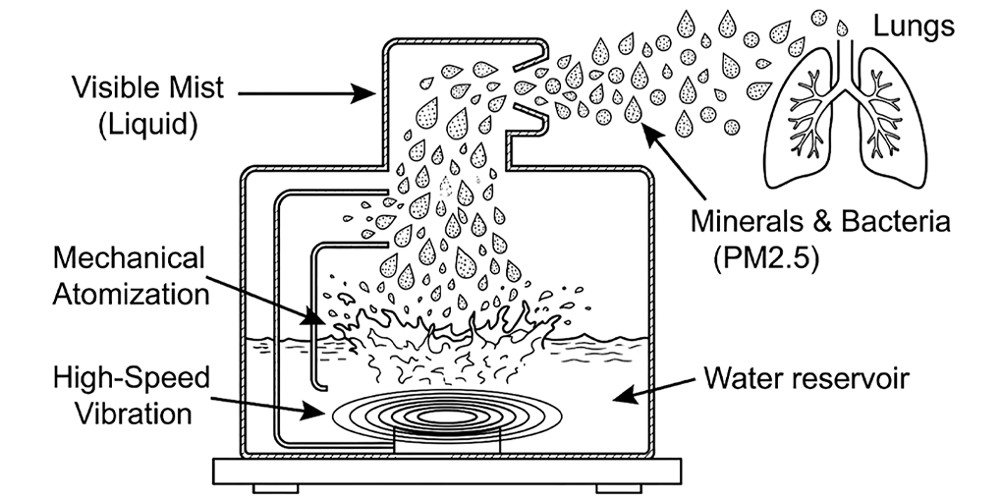
The Mechanism: It physically throws liquid water into the air.
The Flaw: Because it is mechanical, it throws everything contained in the water into the air. This includes H₂O, but also calcium, magnesium, and dissolved bacteria.
The Particle Problem:
- Ultrasonic droplets are 1 to 5 microns in size.
- This is large enough to carry solid particles. Minerals and bacteria ride inside these droplets deep into your lungs.
- When the water evaporates, the minerals fall out as “White Dust” (PM2.5 pollution).
A Personal Warning: I learned this the hard way. Years ago, I placed an ultrasonic unit near my home theater setup. Two days later, my black receiver and TV screen were covered in a fine layer of white powder. It wasn’t dust. It was pulverized calcium from my tap water. I was breathing that.
2. Warm Mist Humidifiers (Steam)
This is simple boiling. A heating element boils water, and steam expands into the room.
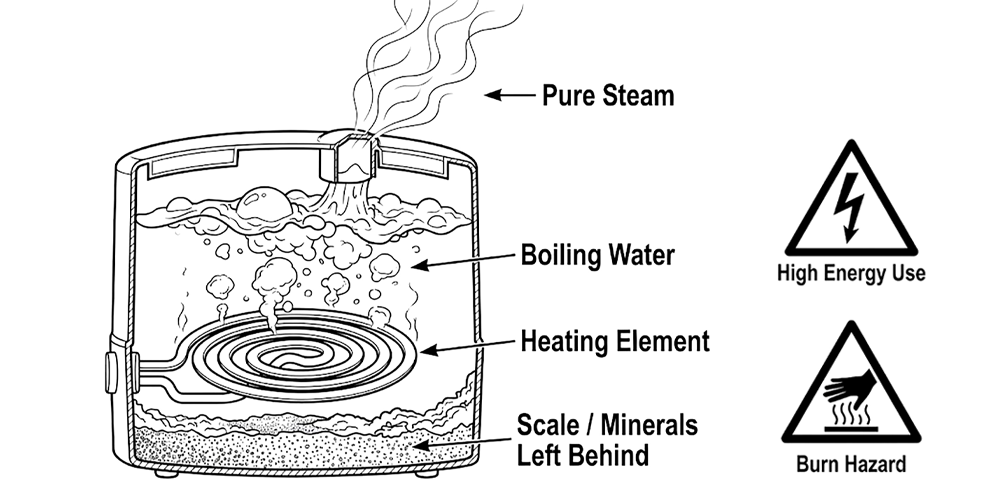
The Mechanism: Pure phase change. Bacteria are killed by heat, minerals are left behind in the machine as scale.
The Flaw: It consumes significantly more electricity (often 10x more than other types) and is a burn hazard. It works, but it’s an inefficient solution.
3. Evaporative Humidifiers (Phase Change)
This is the technology we recommend. It uses a fan to blow air through a wet filter (wick) or rotating discs.
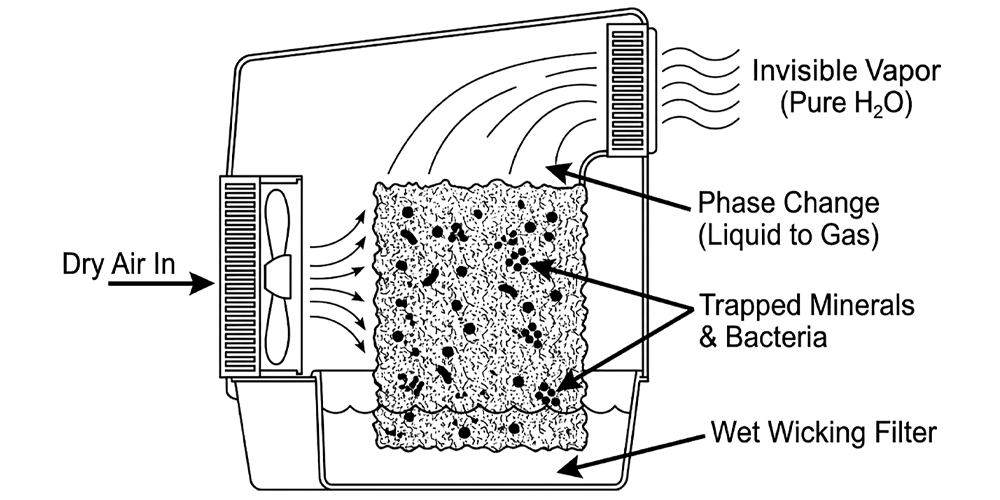
The Mechanism: This forces a natural phase change from liquid to gas inside the machine.
The Engineering Advantage:
- Evaporative humidifier vs steam humidifier: Unlike steam, it uses very little energy. Unlike ultrasonic, it produces zero white dust.
- A water vapor molecule is approximately 0.0004 microns.
- Bacteria and minerals are physically too heavy to evaporate. They get trapped on the filter wick, which you throw away (or wash). Only pure, hydrated gas leaves the machine.
Conclusion: True humidification is invisible. If you see a cloud, you are seeing a chemical cocktail.
We tested this technology for 120 days. Read our full Honeywell HCM-350B evaporative humidifier review
Tech Showdown: Ultrasonic vs. Evaporative
| Feature | Ultrasonic (Mist) | Evaporative (Vapor) |
| Particle Size | 1 – 5 microns (Huge) | 0.0004 microns (Tiny) |
| White Dust Risk | High (Unless distilled water) | Zero (Filter traps it) |
| Bacteria Risk | High (Aerosolizes tank water) | Low (Cannot evaporate) |
| Maintenance | Weekly Scrubbing | Filter Swap / Rinse |
| Our Verdict | Avoid | Recommended |
The “Pink Slime” Reality: Why Mold Grows
Now that we understand the mechanics, let’s talk about the biology inside the tank. Search data shows people are terrified of this: do humidifiers cause mold?
The short answer is: Yes, if you let them.
The “Petri Dish” Effect
A humidifier tank provides the ideal environment for microorganisms: Water, Warmth, and Darkness. If water sits for 24 hours, the chlorine dissipates, and biofilm begins to form.
What is that “Pink Mold”?
You’ve likely seen a pinkish, slimy ring around your water line.
The Identity: It is usually not mold, but a bacteria called Serratia marcescens. It feeds on fatty dust particles and minerals in the water.
Is pink mold in humidifier dangerous? For healthy adults, it is an irritant. For the immunocompromised, it is a risk.
The Safety Barrier: Why Evaporative Wins
In an Ultrasonic Machine: The machine doesn’t care if the water is contaminated. It vibrates the water—bacteria and all—and launches it into the air.
In an Evaporative Machine: Even if biofilm forms in your tank (which you should prevent by cleaning), the bacteria cannot evaporate. They remain trapped in the tank until you wash it.
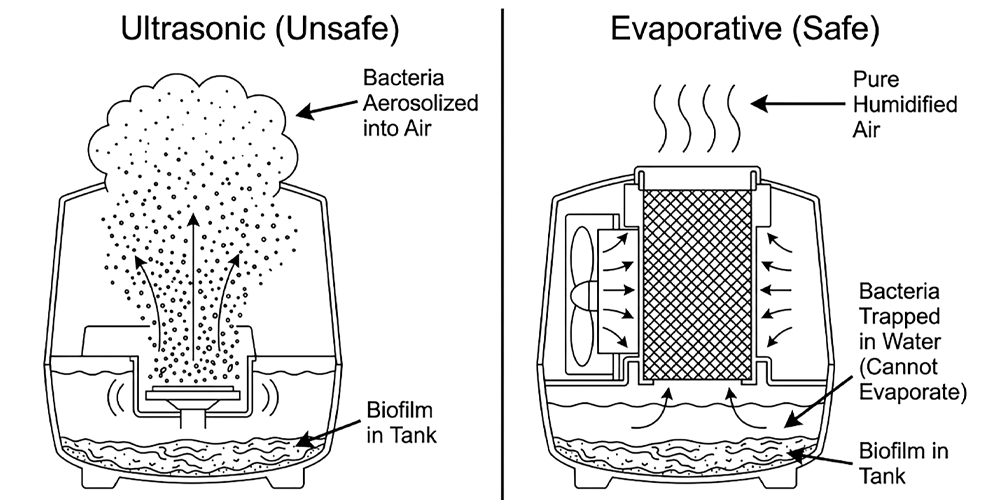
The Verdict: If you are worried about can humidifiers cause mold sickness, an evaporative humidifier creates a physical firewall between the biological water and the air you breathe.
System Design – Whole House vs. Portable
Now that you know how to humidify (Evaporative), you need to decide where to humidify.
1. The HVAC Solution: Whole House Humidifiers
For homeowners with forced-air heating, you might consider a whole home humidifier installation. These units attach directly to your furnace and inject moisture into the heated air moving through your ducts.
When weighing the pros and cons of whole house humidifier systems, the trade-off is clear. While they offer the luxury of being invisible and silent, they come with significant downsides: expensive installation and the risk of mold growth inside your ductwork (which is a nightmare to clean) if the humidity sensor fails.
2. The Room Solution: Portable Unit
For most renters and nurseries, a portable unit is safer and easier to control.
If searching for where to put a humidifier in bedroom, think “Elevated and Central.”
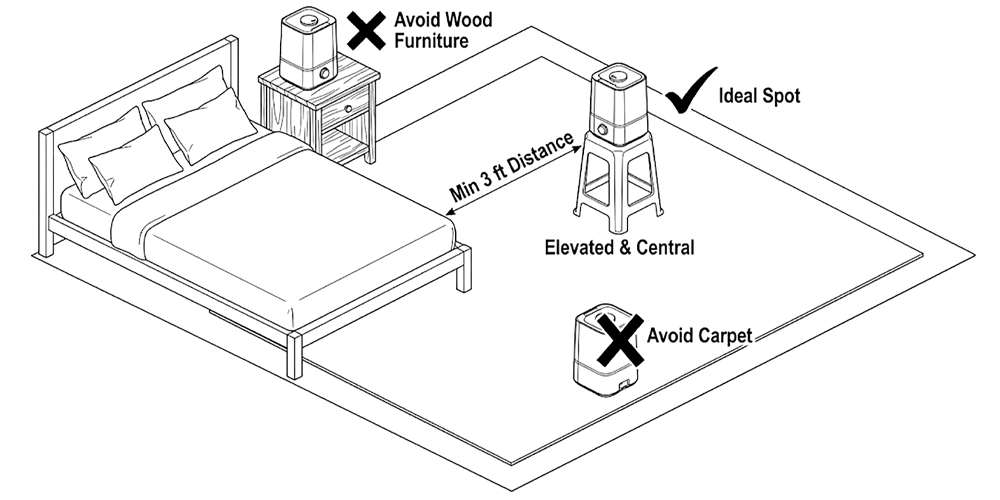
- Avoid Wood: Do not place it on wooden furniture (moisture damage).
- Avoid Carpet: Do not place it directly on carpet (airflow restriction and mold risk).
- Ideal Spot: On a plastic stool or composite surface, at least 3 feet away from the bed.
Note on Plants: If you are using a humidifier for money tree or humidifier for majesty palm, evaporative units are also superior. Plants “breathe” through stomata (pores). The mineral dust from ultrasonic mist can clog these pores just as it irritates human lungs.
Buying Guide – Sizing & Real Features
Marketing boxes are full of misleading specs. They claim a tiny 1-liter device covers a “Large Room.” Physics disagrees.
1. The “Gallon Rule”: Don’t Trust Square Footage
Square footage ratings are tested in sealed lab chambers. Your house leaks air. Ignore the “Sq Ft” on the box. Look at Water Tank Capacity.
The Reality Check: Trying to humidify a standard adult bedroom with a small tank (<1 gallon) is a recipe for failure. On the “High” setting needed to fight dry air, it will run dry in just 6 hours. You wake up at 4 AM with a dry throat.
The Engineering Rule: Bigger is always better. You need 24-hour runtime.
| Room Size | Example Space | Tank Size Needed |
| Small Room | Baby Nursery, Home Office | Minimum 1.0 Gallon |
| Medium Room | Master Bedroom, Living Room | 1.5 – 2.0 Gallons |
| Large Space | Open Floor Plan, Whole Condo | 3.0 – 4.0 Gallons |
2. The Golden Rule of Hygiene: Tank Access
In a physical store, I would tell you to try the “Hand Test”: If you cannot fit your entire hand inside the tank to scrub the corners, don’t buy it.
But since you are buying online, here is how to spot a fake:
Ignore “Easy Clean” labels: Marketing lies.
Look at the photos: If the water tank has a tiny screw-cap (usually on the bottom), it’s a mold trap. You need a “Wide Mouth” or “Top Fill” design that looks like a bucket.
Engineer’s Promise: You don’t need to guess. I have verified that all 3 recommendations below have massive openings that pass the “Hand Test.” You can wipe every inch of them clean.
The Engineer’s Top Picks
Based on the strict criteria above—Safety (No White Dust) and Hygiene (Passes the Hand Test)—here are the only three machines worth your money.
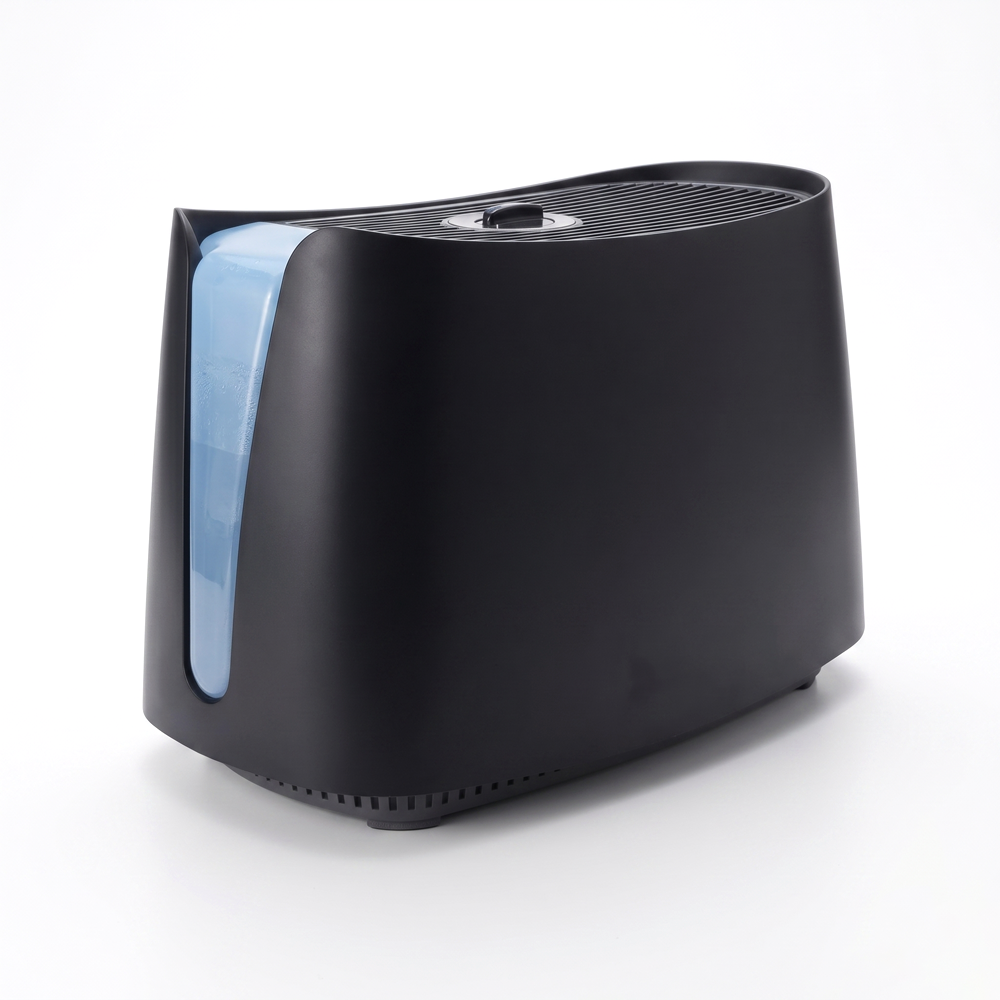
The “Easy Clean” Value Pick: Honeywell HCM-350 Germ-Free
The most popular evaporative unit for a reason. It looks medical, but it works. (Check Price on Amazon)
| Performance & Accuracy | 22/25 |
| Reliability & Durability | 23/25 |
| Ease of Use & Cleaning | 19/20 |
| Design & Safety | 11/15 |
| Price-to-Performance | 14/15 |
| Value Index | 89/100 |
Why: It features a UV light to reduce bacteria and has a massive tank opening that is incredibly easy to wipe down by hand.
Best For: Nurseries and budgets.
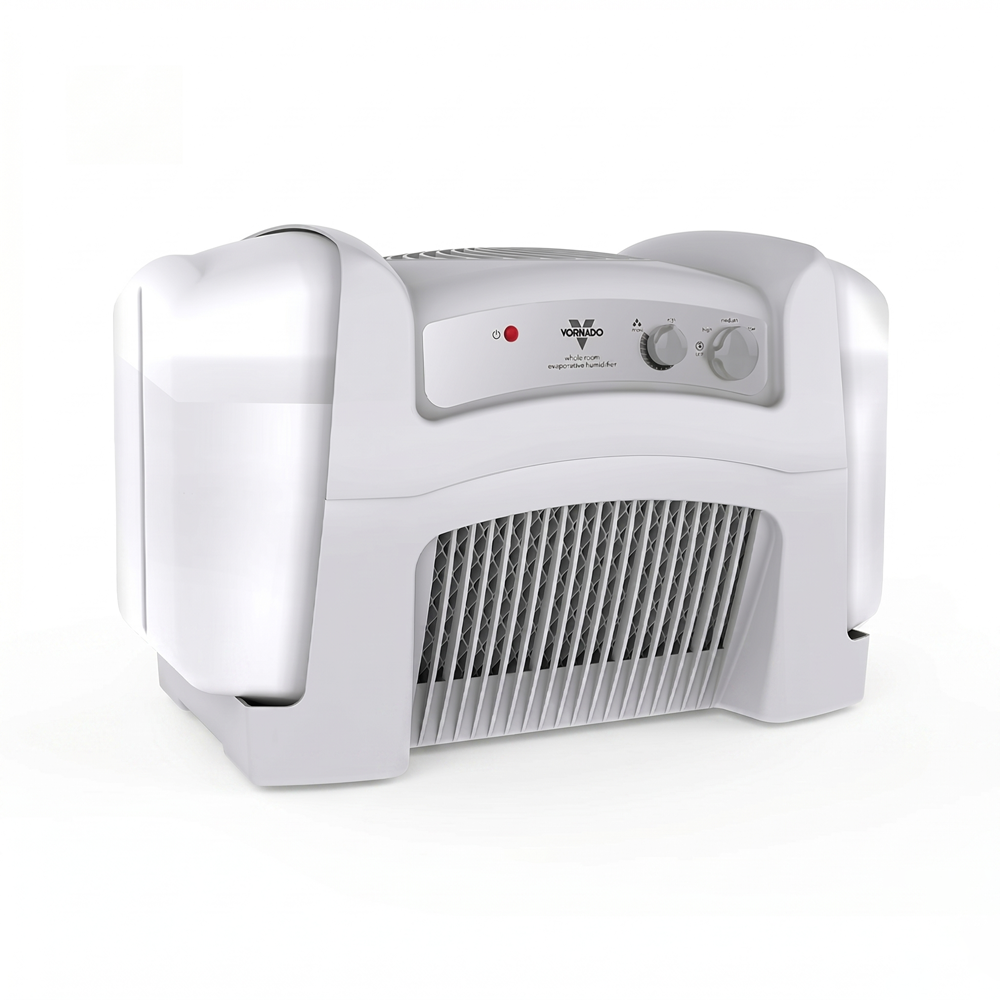
The “Whole Home” Alternative: Vornado Evap40
If you don’t want a whole home humidifier installation, this is the portable alternative. (Check Price on Amazon)
| Performance & Accuracy | 23/25 |
| Reliability & Durability | 22/25 |
| Ease of Use & Cleaning | 15/20 |
| Design & Safety | 13/15 |
| Price-to-Performance | 14/15 |
| Value Index | 87/100 |
Why: “Vortex Action” circulates air across the whole house. 4-gallon tank means fewer refills.
Best For: Large apartments and open floors.
The “Filterless” Pick: Venta Airwasher (LW25)
This machine uses a stack of plastic discs rotating in water instead of a disposable filter. (Check Price on Amazon)
| Performance & Accuracy | 18/25 |
| Reliability & Durability | 25/25 |
| Ease of Use & Cleaning | 16/20 |
| Design & Safety | 12/15 |
| Price-to-Performance | 12/15 |
| Value Index | 83/100 |
Why: It solves the cost of replacing a humidifier filter. It’s a “buy once, cry once” investment.
Maintenance: Simply rinse the disc stack in the shower or sink. No wick to buy, no white dust to fear.
Best For: Long-term savers and living rooms.
Before You Buy: The 3-Step Check
Step 1: The Technology Check. Evaporative = invisible vapor. Ultrasonic = visible mist. If you see a cloud, you’re breathing dissolved minerals. Pick evaporative unless you’re committed to distilled water.
Step 2: The Tank Size Check. Ignore square footage claims. Look at the tank: 1 gallon = small room. 1.5–2 gallons = master bedroom. 3–4 gallons = open floor plan. Bigger is always better — you want 24-hour runtime between refills.
Step 3: The Hand Test. If you can’t fit your whole hand inside the tank opening, don’t buy it. A narrow neck means you’ll never clean it properly. The “Easy Clean” label is marketing. Your hand is the only test that matters.
The Verdict: Physics Over Marketing
Buying a humidifier feels complicated because marketing makes it that way. Physics makes it simple.
Remember the core principle: Visible mist means you are breathing dissolved solids (white dust). Invisible vapor means you are breathing pure hydrated air.
Our advice? Don’t worry about how the machine looks. It’s an appliance, not a decoration. Pick the evaporative model that fits your room size and maintenance style. Your lungs (and your electronics) will thank you.
FAQ
Do I really need to use distilled water?
If you buy Ultrasonic, YES. You must prevent PM2.5 “white dust” from coating your lungs. If you buy Evaporative (our recommendation), NO. The filter traps the minerals. Tap water is fine.
Will an evaporative humidifier make my room feel cold?
Slightly. It creates a “sea breeze” effect. But unlike “Warm Mist,” it is 100% safe for kids (no boiling water).
Is “Cool Mist” the same as “Ultrasonic”?
Not always. “Cool Mist” is a marketing term. Check the box: if it has a filter/wick, it’s Evaporative (Good). If it has a mist nozzle but no filter, it’s Ultrasonic (Needs distilled water).
How often do I need to clean it?
Rinse the tank weekly. Replace wicking filters every 1–2 months before they get crunchy.
What is the ideal humidity level?
Target 40% to 50%. Anything below 30% is too dry for your sinuses; anything above 60% invites mold growth on your walls. This is why a built-in humidistat is a must-have feature.
Not sure if a humidifier is enough? Read our full breakdown: Humidifier vs Dehumidifier vs Air Purifier — How to Choose the Right One
Related Articles
Home Safety & Air Quality: The Complete Guide (2026)
Honeywell HCM-350B Review (2026): Why We Almost Returned It
Humidifier vs Dehumidifier vs Air Purifier
Meet the Team
DontPickIt Home Lab
“Your home is a complex ecosystem. We analyze everything that plugs in, turns on, or helps you relax. From mastering your indoor climate to automating your kitchen and cleaning routines, we test products against dust, hard water, and daily chaos. Our goal: finding tools that solve problems without creating new ones.”