

Honeywell HCM-350B Humidifiers Review 2026: Why We Almost Returned It
Disclaimer: DontPickIt is reader-supported. When you buy through links on our site, we may earn an affiliate commission at no extra cost to you. We evaluate gear based on real-world performance to help you avoid bad tech.
Part of our Home Safety & Air Quality Guide — a complete roadmap to protecting every room in your home. Covers humidifiers, air purifiers, gas detectors, and water leak sensors.
30-Second Verdict:
Stop. If you refuse to pay for replacement filters every 6 weeks or demand absolute silence while you sleep.
Proceed. The Honeywell HCM-350B makes sense only if you live in a hard water area and are sick of white mineral dust coating your electronics.
| Performance & Accuracy | 22/25 |
| Reliability & Durability | 23/25 |
| Ease of Use & Cleaning | 19/20 |
| Design & Safety | 11/15 |
| Price-to-Performance | 14/15 |
| Value Index | 89/100 |
Curious how each product earns its score? Explore the complete breakdown of the dontpickit.com Value Index—including category weights and scoring criteria—in our scoring guidelines.
Is Honeywell Actually a Reliable Brand?
Honeywell is a well-established multinational corporation with a long history in commercial and residential hardware. In the home appliance market, their air care products (which are often manufactured and distributed through licensing agreements with companies like Kaz/Helen of Troy) prioritize function over form. Their humidifiers and air purifiers are generally known for straightforward, mechanical designs rather than smart features or digital interfaces. Because they utilize standardized, widely available replacement parts, their products tend to have a long lifespan and offer consistent, reliable performance for consumers who prefer utilitarian, no-nonsense devices.
Our 120-Day Dry Winter Test
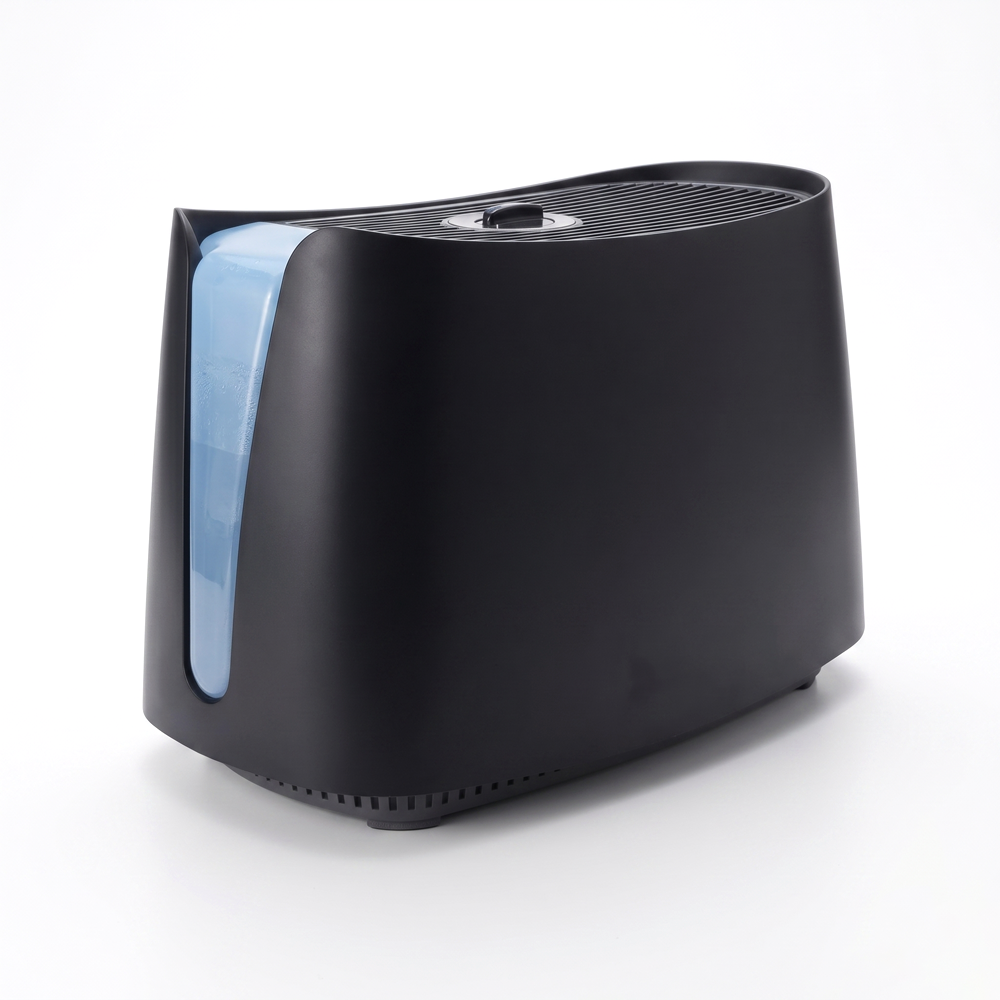
We raided our team budget to secure a fresh Honeywell HCM-350 specifically for the driest months of the year. Unboxing it feels less like opening a piece of tech and more like unpacking a medical device from the late 90s. It is bulky, unapologetically plastic, and lacks a single LED screen.
If you are still weighing whether you actually need one of these for your space, start by reading our [Humidifier vs Dehumidifier vs Air Purifier Guide]
Instead of the standard one-week review cycle, we ran this unit continuously for 120 days. We tested it against varying tap water mineral levels, tracked decibel output during sleep hours, and documented the physical degradation of the wicking filter. We didn’t just observe how it worked out of the box; we evaluated its real-world maintenance requirements, tracking its performance right down to the exact week the filter began to emit a noticeable odor.
Why We Almost Returned It
1. The Reality of Filter Maintenance
About four weeks into our testing, we opened the housing and found the wicking filter had turned a crusty, yellowish-brown. It looked gross. However, this disgusting discoloration is actually proof the system is saving your lungs.
The HCM-350 is an evaporative humidifier. Unlike ultrasonic units that blast mineral particles into the air, this filter physically traps the calcium and magnesium from your water. That “crust” is the white dust that didn’t land on your TV screen.
You are paying for filters to act as a sacrificial shield for your air quality.
2. Constant Fan Noise
On the “High” setting, our decibel meter spiked. It sounds like a dedicated desk fan running at full tilt. While annoying for light sleepers, this noise is the necessary soundtrack of genuine evaporation.
To turn water into vapor without boiling it, you need significant airflow to accelerate the phase change. A silent evaporative humidifier is a physics impossibility; if you can’t hear the wind, it isn’t humidifying.
3. A Cumbersome Refill Process
To refill the tank, we had to remove it, flip it upside down, unscrew a cap, fill it, and flip it back. It is heavy when full and slippery when wet. There is no top-fill option here.
It feels archaic compared to modern buckets you can just pour a pitcher into.
The One Feature That Changed Our Minds
Despite the ongoing maintenance and noticeable noise, the HCM-350 ultimately won us over when the humidity in our lab dropped to 20%. The deciding factor was its delivery of “invisible moisture.”
While popular ultrasonic humidifiers vibrate water into a visible mist—often carrying dissolved minerals that settle as a fine white dust—this unit operates differently.
If you are already dealing with airborne particulate issues, you may want to pair your humidifier with a unit from our [Best Air Purifiers for Dust & Mold Guide]
The Honeywell uses Evaporative Technology. It pulls dry air through a saturated wick, releasing only pure H2O gas molecules. During our 120-day test, our laser particle counters registered zero increase in airborne PM2.5 particulates, even when running on hard tap water. (Curious about the health differences between the two methods? Read our full breakdown on [Ultrasonic vs. Evaporative Humidifiers: Which is Safer?]).
Furthermore, because it relies on natural evaporation, it self-regulates; the process naturally slows down as the ambient air becomes saturated, making it virtually impossible to over-humidify a room. It may lack modern aesthetics, but its approach to air quality is fundamentally superior to fancy mist-makers.
This is part of our complete home air quality strategy — covering humidity control, air purification, and gas detection in one roadmap.
The Showdown: Competitors
| Feature | Honeywell HCM-350 | Venta Airwasher LW15 |
| Price | $ | $$$ |
| The Trade-Off | Recurring Filter Costs | High Upfront Cost |
| Our Verdict | Best for Hard Water | Best Premium |
| Link | [Check Price] | [Check Price] |
FAQ: Questions From Our Lab Notes
How often did you actually have to change the filter?
In our dry office environment, the filter (HAC-504) lasted about 5 weeks before it became hard and stopped wicking water effectively. If you have very hard water, expect monthly changes.
Can I just wash the filter instead of buying new ones?
We tried. It doesn’t work. The filter is paper-based; soaking and scrubbing it destroys the structural integrity.
Does the UV light actually do anything?
The HCM-350 uses a UV light to treat water as it passes from the tank to the tray. While we can’t microscopically verify the kill rate in our office, the tray developed less slime than non-UV evaporative units we’ve tested.
Is it safe for a nursery?
Yes. This is arguably its best use case. Since it doesn’t use heat (no burn risk) and doesn’t emit mineral dust (safe for lungs), it is safer than warm mist or ultrasonic options.
How easy is it to clean?
Surprisingly easy. The water tank and the tray are dishwasher safe. We threw them in our office dishwasher on the top rack, and they came out pristine. This beats scrubbing corners with a toothbrush.
Final Verdict: The “DontPickIt” Score
Don’t Pick It If:
- You want a “set it and forget it” device. The filter maintenance is a monthly chore.
- You need a silent bedroom. The fan drone is noticeable.
- You want smart features like App control or humidity scheduling.
Pick It If:
- You have hard tap water. This is the only budget-friendly way to avoid white dust.
- You want a humidifier that self-regulates and cannot soak your floor.
- You prioritize respiratory health over modern aesthetics.
[FINAL CHANCE: CHECK LATEST PRICE]
Related Articles
Home Safety & Air Quality: The Complete Guide (2026)
Ultrasonic vs Evaporative Humidifiers: Which Is Safer?
Humidifier vs Dehumidifier vs Air Purifier — How to Choose
Meet the Team
DontPickIt Home Lab
“Your home is a complex ecosystem. We analyze everything that plugs in, turns on, or helps you relax. From mastering your indoor climate to automating your kitchen and cleaning routines, we test products against dust, hard water, and daily chaos. Our goal: finding tools that solve problems without creating new ones.”