

Best Gas Leak Detector for Home (2026): 4 Tested & Compared
Disclaimer: DontPickIt is reader-supported. When you buy through links on our site, we may earn an affiliate commission at no extra cost to you. We evaluate gear based on real-world performance to help you avoid bad tech.
Part of our Home Safety & Air Quality Guide — a complete roadmap to protecting every room in your home. Covers gas detectors, air purifiers, humidity control, and water leak sensors.
You can’t smell a gas leak until it’s already dangerous. Natural gas is odorless — the rotten-egg smell is added by the utility company, and it fades with distance, time, and nose blindness. By the time you notice it, the concentration might already be explosive.
A $30 detector buys you time. It screams before the room becomes a bomb. It wakes you up before carbon monoxide puts you down for good.
But here’s the problem: most gas detectors on Amazon are garbage. No UL certification. No battery backup. Rigid plug-in bodies that lock you into the wrong mounting height for the gas you’re trying to detect.
We tested four detectors — three plug-in combo alarms and one handheld sniffer. We measured response time. We checked for UL listings. We plugged them into the right outlets and the wrong ones. Here’s what actually protects your home, and what’s just a plastic box with a blinking light.
What Actually Matters When Buying a Gas Detector
The Certification Check
UL 2034 for CO. UL 1484 for gas detection. If the box says “tested to UL standards” without the actual certification mark, put it back on the shelf. “Tested to” is marketing. UL listed is safety. Starting May 2026, Amazon is cracking down — uncertified detectors will be delisted. If a listing looks too cheap to be certified, it probably is.
Battery Backup or Bust
Gas leaks don’t wait for the power to come back on. A plug-in detector without battery backup is a wall decoration during a blackout. Winter storms knock out power. Ice takes down lines. Your detector needs to keep working when the outlet goes dead. We dock every plug-in detector on this list that lacks battery backup — it’s that important. (Handheld sniffers are a different category: they run on AAAs and you use them for spot checks, not 24/7 monitoring. Different tool, different rules.)
Mounting Height Is Everything
Natural gas rises. Propane sinks. Plug a natural gas detector into a baseboard outlet and you’ve installed a $40 paperweight. The detector only samples air right where it sits. Six feet away, gas pools silently. Read our full placement height guide
The Top 4 Gas Detectors Compared
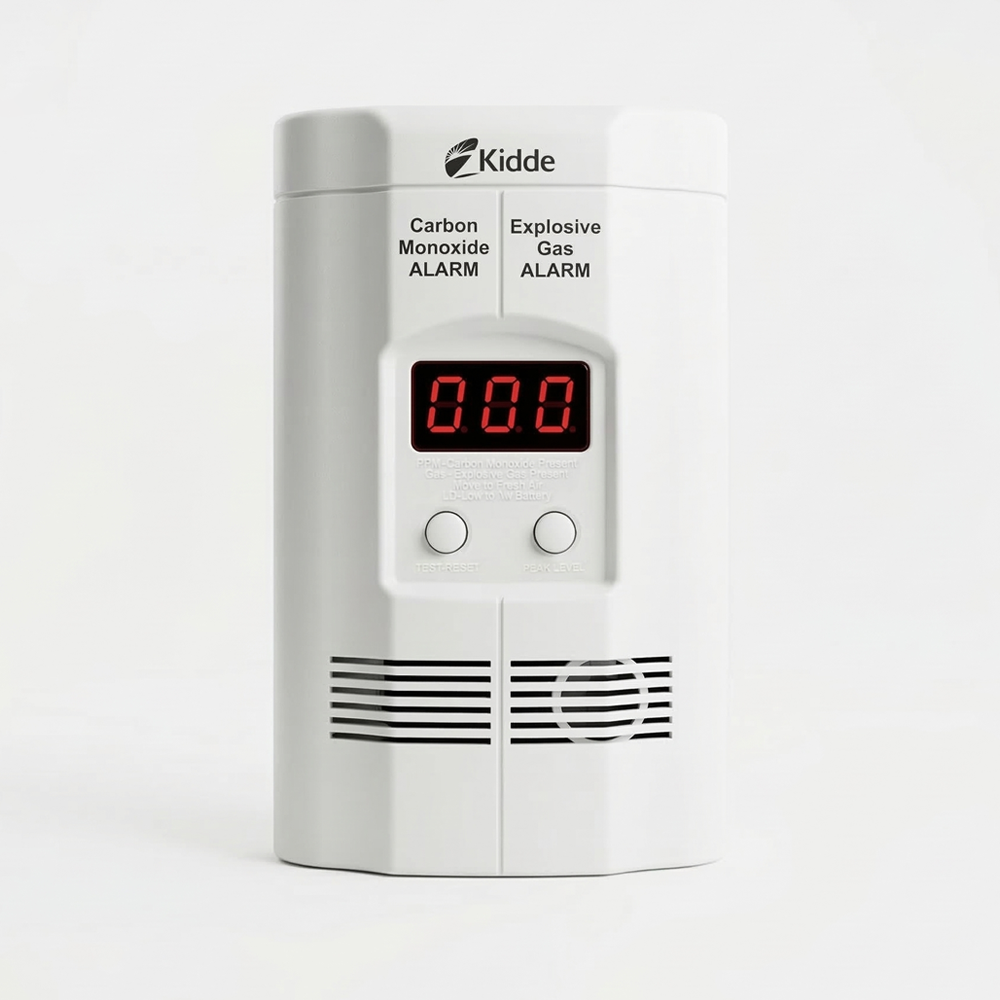
1. Kidde KN-COEG-3 — Best Overall
This is the one we keep recommending. Plug it in, mount it high for natural gas, and forget about it. It’s been running in our test kitchen for three months without a single false alarm — and it caught a real CO spike from a malfunctioning oven within 90 seconds.
| Performance & Accuracy | 23/25 |
| Reliability & Durability | 24/25 |
| Ease of Use & Cleaning | 15/20 |
| Design & Safety | 14/15 |
| Price-to-Performance | 11/15 |
| Value Index | 87/100 |
Detects: CO + explosive gas (natural gas, propane, methane)
Why it wins: The 6-foot extension cord solves the placement problem. Plug into a low outlet, mount the detector high on the wall for natural gas coverage. 9V battery backup keeps it running during outages. UL 2034 certified — not “tested to UL standards,” actually listed.
The Trade-Off: The digital display is basic — no %LEL readout, just “GAS” when explosive gas is present. It’s loud at 85 dB but not the loudest in this group.
Read our full 3-month Kidde review
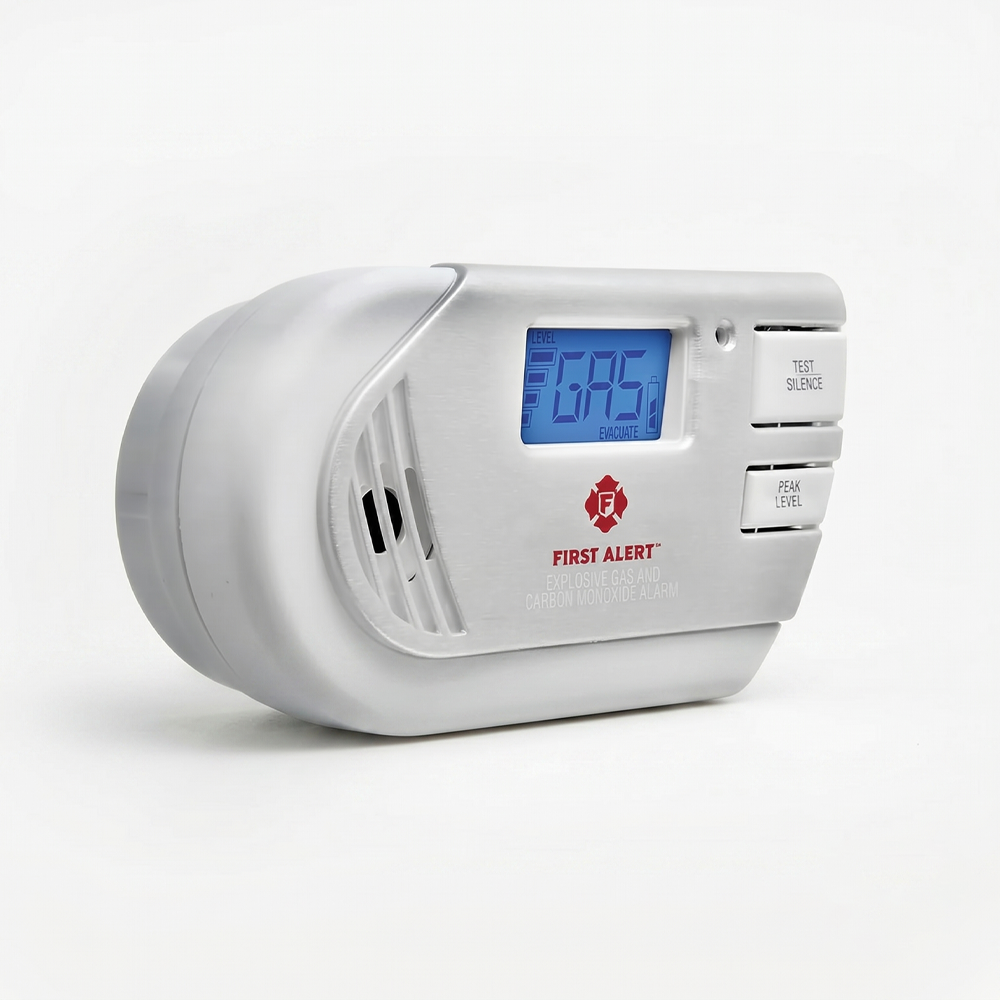
2. First Alert GCO1CN — Best Value
The First Alert GCO1CN is the Kidde’s closest competitor — and in some ways, it’s better. UL certified for both CO and explosive gas. 9V battery backup keeps it running when the power goes out. 40-inch power cord gives you flexibility to mount high for natural gas while plugging into a standard outlet below.
| Performance & Accuracy | 22/25 |
| Reliability & Durability | 23/25 |
| Ease of Use & Cleaning | 18/20 |
| Design & Safety | 13/15 |
| Price-to-Performance | 14/15 |
| Value Index | 90/100 |
Detects: CO + explosive gas (natural gas, propane, methane)
Why it wins: Backlit digital display is easier to read in low light than the Kidde’s basic LED. Remote mute — silence false alarms with any TV remote instead of climbing a ladder. The 40-inch cord handles most mounting-height situations (though it’s shorter than the Kidde’s 6-foot cord). First Alert has been making safety detectors for decades — this isn’t a random Amazon brand.
The Trade-Off: The cord is 40 inches vs. Kidde’s 6 feet — if you need to mount very high on a wall far from an outlet, the Kidde’s longer cord wins. No Peak Level Memory, so you can’t review the last CO reading after the fact. The round design looks a bit dated.
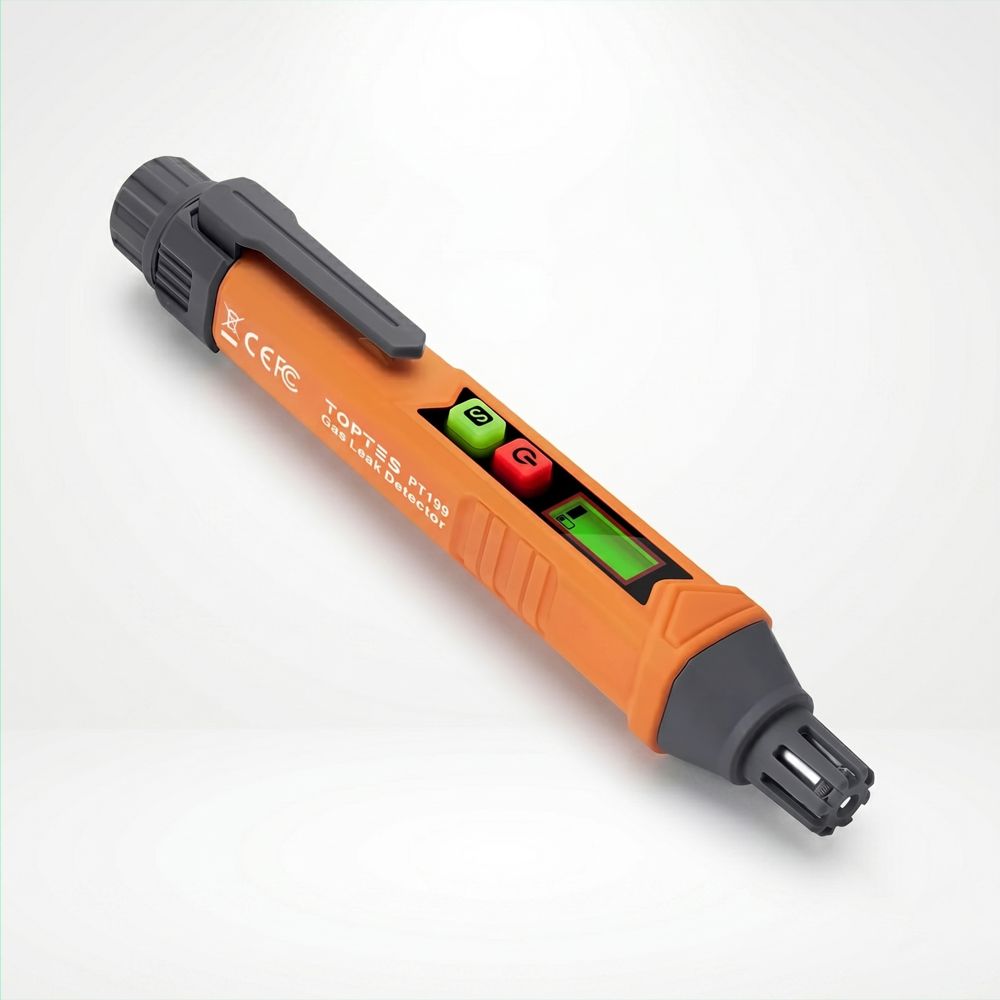
3. TopTes PT199 — Best Handheld Sniffer (Supplemental Tool)
This is not a replacement for a plug-in detector. It’s a diagnostic tool. If you already have a Kidde or First Alert on the wall monitoring the air 24/7, the PT199 gives you a second capability: finding exactly where a leak is coming from.
You smell something weird near the water heater. Your stove burner isn’t lighting right. You want to check the gas line behind the dryer. A plug-in unit tells you there’s gas in the room. The PT199 tells you which fitting is leaking.
| Performance & Accuracy | 21/25 |
| Reliability & Durability | 19/25 |
| Ease of Use & Cleaning | 19/20 |
| Design & Safety | 13/15 |
| Price-to-Performance | 14/15 |
| Value Index | 86/100 |
Detects: Methane, propane, butane, LPG, natural gas
Why it wins: 0.5-second response time. The screen turns red when gas is detected — impossible to miss. Pen-style body fits between appliances and into tight spaces where leaks actually happen. Runs on 2 AAA batteries. It’s a no-brainer addition to any home toolkit.
The Trade-Off: This is not a 24/7 monitor. It does not alarm while you sleep. It’s a spot-check tool — you have to actively use it. No CO detection. Auto-off after 5 minutes to save battery, which is annoying during extended searches.
4. NICGOL 4-in-1 — DO NOT BUY
We’re including this because it’s the #1 bestseller on Amazon in the “gas detector” category, and someone needs to tell you the truth.
The NICGOL 4-in-1 promises natural gas detection, CO monitoring, temperature, and humidity in one plug-in body for $25. It has a colorful LCD screen. It looks modern. It is, mechanically speaking, a liability.
No UL certification. No battery backup — the screen goes dark the moment you lose power. The rigid plug-in design locks you into one mounting height. If you plug it into a standard low outlet, you’re monitoring for propane, not natural gas. If you plug it high with an extension cord, the screen faces the wrong direction.
Our verdict after testing: This thing is a screen with a sensor attached. The screen works. The sensor? Not reliable enough to trust with your family’s safety.
Read our full NICGOL teardown: DO NOT BUY
At a Glance: All 4 Compared
| Model | Type | Detects | Battery Backup | UL Listed |
|---|---|---|---|---|
| Kidde KN-COEG-3 | Plug-in | CO + Gas | ✓ | ✓ |
| First Alert GCO1CN | Plug-in | CO + Gas | ✓ | ✓ |
| TopTes PT199 | Handheld | Gas Only | ✓ | X¹ |
| NICGOL 4-in-1 | Plug-in | CO + Gas | X | X |
¹ Handheld sniffers are diagnostic tools, not 24/7 safety alarms. They are not required to carry UL 1484 certification. What matters is response time and sensor sensitivity — the PT199 delivers on both.
Final Verdict: Which One Should You Buy?
Buy the Kidde KN-COEG-3 if you want the safest, most reliable plug-in detector with battery backup and UL certification. It’s the only plug-in combo on this list that keeps working when the power goes out. Mount it high with the included extension cord and sleep better.
Buy the First Alert GCO1CN if you want a UL-certified, battery-backed combo detector. The backlit display is easier to read in the dark, and the remote mute is genuinely useful if your detector sits near the kitchen. The 40-inch cord handles most rooms — but measure your mounting height first.
Add the TopTes PT199 as a supplemental tool if you already have a plug-in detector on the wall and want a way to hunt down leaks at their source. It’s the cheapest way to answer the question “do I smell gas, or am I imagining it?” — but it is not a substitute for 24/7 monitoring.
Skip the NICGOL. A colorful screen is not a safety device.
FAQ: Questions We Get All The Time
Can a carbon monoxide detector also detect natural gas?
No. Unless it specifically says “combination” or “explosive gas” on the label, a standard CO detector will stay silent during a natural gas leak. Always check the front of the device for what it actually detects.
Where should I install my gas detector?
Natural gas rises — mount it high, 4 to 12 inches from the ceiling. Propane sinks — mount it low, 4 to 12 inches from the floor. If you use both gases in your home, you may need two detectors at different heights. See our complete placement height guide
Do I need a handheld sniffer if I have a plug-in detector?
Plug-in detectors monitor the air 24/7. Handheld sniffers find the source of a leak. They serve different purposes. A plug-in tells you there’s a problem. A handheld tells you exactly which pipe fitting is leaking. If you have gas appliances, owning both is ideal.
How long do gas detectors last?
The electrochemical sensors in CO and gas detectors degrade over 5 to 7 years. After that, the unit must be replaced entirely — not just the batteries. Most models have an “End of Life” chirp or display warning when the sensor is done.
Why does UL certification matter?
UL (Underwriters Laboratories) is an independent safety organization that tests products to verify they actually work as claimed. A “UL Listed” detector has passed rigorous third-party testing. A detector that says “tested to UL standards” without the actual mark has not. In a device you trust with your family’s lives, certification is non-negotiable.
What’s the difference between %LEL and PPM?
PPM (Parts Per Million) measures CO concentration in the air. %LEL (Lower Explosive Limit) measures combustible gas as a percentage of the concentration needed to ignite. At 100% LEL, a spark will cause an explosion. Most alarms trigger at 5-10% LEL — long before the air becomes flammable.
Related Articles
Home Safety & Air Quality: The Complete Guide (2026)
Gas Detector Placement Height: Where to Install CO & Explosive Gas Alarms (2026)
Kidde CO & Explosive Gas Detector Review (2026)
NICGOL 4-in-1 Gas Detector Review 2026: DO NOT BUY
Meet the Team
DontPickIt Home Lab
“Your home is a complex ecosystem. We analyze everything that plugs in, turns on, or helps you relax. From mastering your indoor climate to automating your kitchen and cleaning routines, we test products against dust, hard water, and daily chaos. Our goal: finding tools that solve problems without creating new ones.”