

Humidifier vs Dehumidifier vs Air Purifier (2026): How to Choose the Right One
Disclaimer: DontPickIt is reader-supported. When you buy through links on our site, we may earn an affiliate commission at no extra cost to you. We evaluate gear based on real-world performance to help you avoid bad tech.
Part of our Home Safety & Air Quality Guide — a complete roadmap to protecting every room in your home. Covers humidifiers, dehumidifiers, air purifiers, gas detectors, and water leak sensors.
Let’s cut the marketing fluff: Walking into a store to buy an “air machine” usually feels like guessing. Your throat is dry—is it humidity? Your room smells weird—is it mold or just stale air?
We don’t guess at DontPickIt Home Lab. We test.
After analyzing the airflow dynamics and sensor data of 50+ units, here is the truth: Your room’s air is an invisible fluid governed by three physical rules—Energy Conservation, Phase Change, and Airflow.
If you ignore these rules, you aren’t just wasting money. You might be creating a new problem—like turning your bedroom into a petri dish or confusing your smart home sensors.
Here is the engineering breakdown of how to actually control your environment.
Humidifier vs Dehumidifier vs Air Purifier: The Real Differences
1.The Dehumidifier: The “Heat-Generating” Sponge
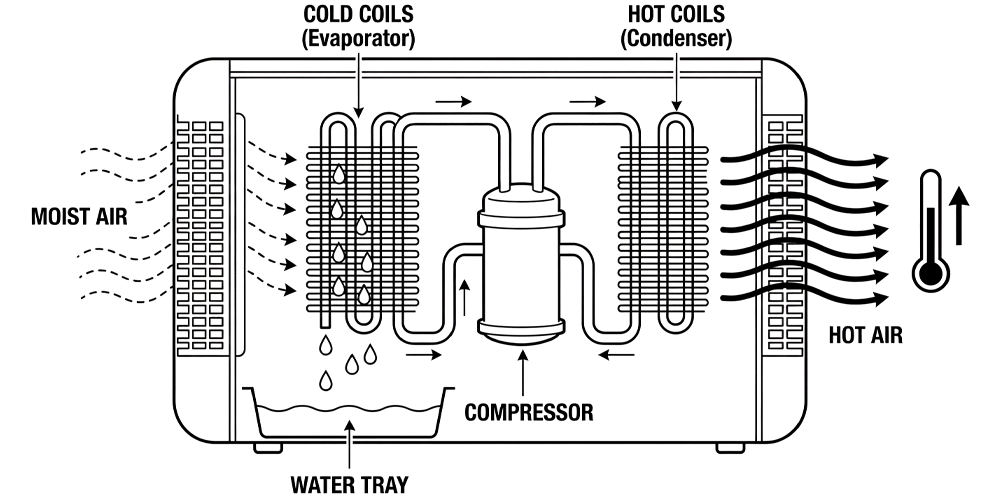
Most people think a dehumidifier is just a “water vacuum.” It’s not. Think of it as a localized Air Conditioner that doesn’t vent outside.
Why It Generates Heat (And Why That Matters)
It sucks in your moist room air and passes it over freezing cold coils. The water in the air condenses (turns from gas to liquid) and drips into a bucket. But here is the catch: Conservation of Energy. To freeze those coils, a compressor has to work hard, generating heat. Plus, when water turns from gas to liquid, it releases “latent heat.”
Common Mistake: The “Dry Sauna” Effect
The “Dry Sauna” Effect Since a dehumidifier blows that hot exhaust air back into your room, it can raise the temperature by 3°C to 5°C (especially in a closed, small room).
The Mistake: Buying this for a hot, humid apartment in July without AC. You will fix the sweat, but you will bake in the heat.
The Fix: Only use huge dehumidifiers in cool basements or in winter. For summer? Your AC is already a giant dehumidifier. Use that instead.
Our Recommendation
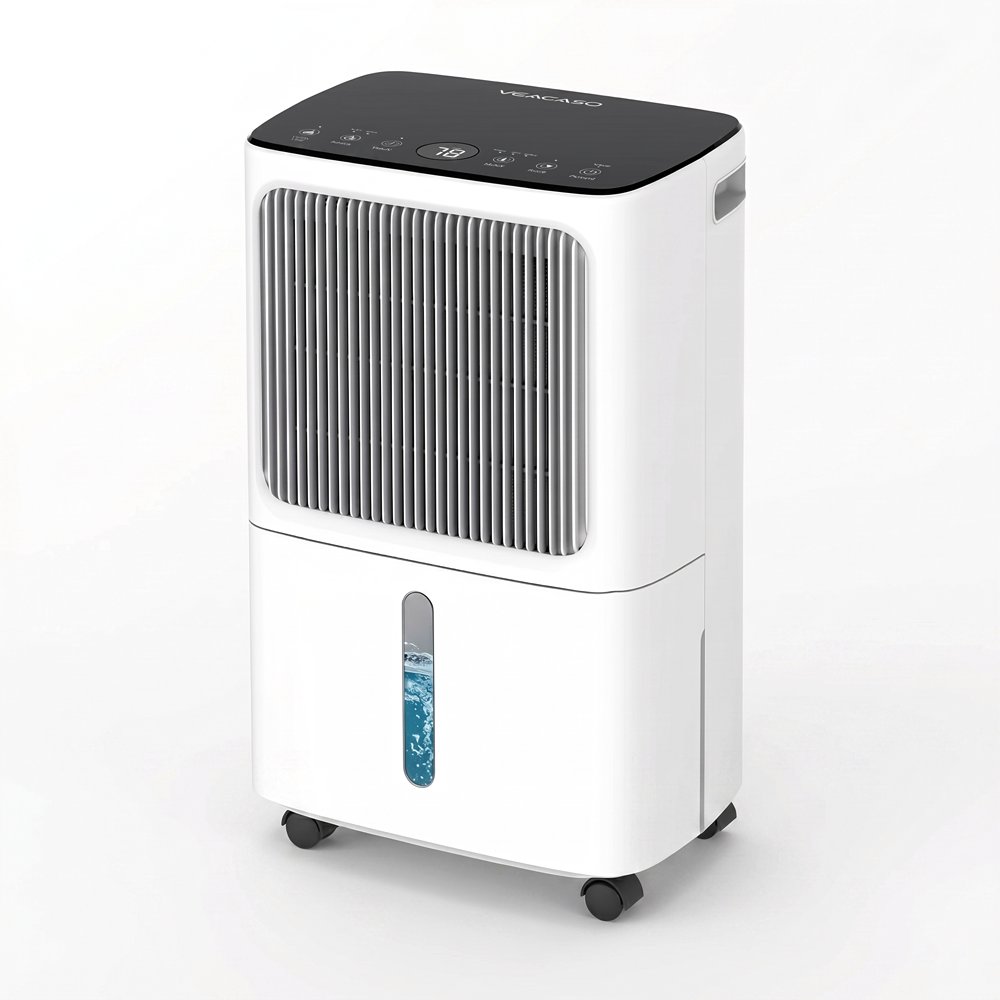
The Quick Pick: Ready to fix that damp basement or bedroom? Here is a smart, efficient choice for medium-sized spaces. VEAGASO 34 Pint Dehumidifier for up to 2,500 Sq. Ft. (Check Price on Amazon)
| Performance & Accuracy | 22/25 |
| Reliability & Durability | 21/25 |
| Ease of Use & Cleaning | 17/20 |
| Design & Safety | 13/15 |
| Price-to-Performance | 15/15 |
| Value Index | 88/100 |
Why we picked it: A powerful unit for its size, offering continuous gravity drainage with an included hose. Perfect for keeping basements or large rooms dry without constant emptying.
Need more details on sizing, pump types, and energy efficiency? Don’t guess. Read our full engineering guide: How to Select the Perfect Dehumidifier for Your Space.
2.The Humidifier: The “Invisible Dust” Creator
When the air is dry, your skin cracks and viruses spread faster. You need water vapor. But how you add that water matters. There are two main types, and one of them can cause unexpected issues.
Ultrasonic vs. Evaporative: The “White Dust” Risk
Ultrasonic (Cool Mist): Uses a vibrating plate to shatter water into a visible mist. It is quiet and cheap.
Evaporative: Uses a fan to blow air through a wet filter (wick). It is noisy but natural.
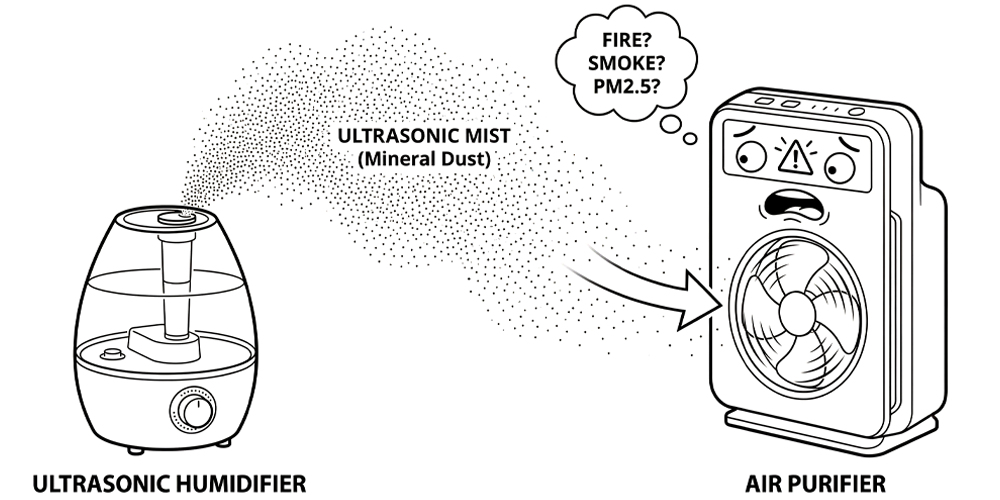
Why does this matter? If you fill an Ultrasonic humidifier with tap water, it shatters the minerals (Calcium, Magnesium) into microscopic white dust. You breathe this over time, and it settles on your furniture and electronics.
Why Your Air Purifier Hates Ultrasonic Models
If you own an Air Purifier, be very careful with Ultrasonic Humidifiers. Here is what happens: The humidifier shoots out mineral dust. The air purifier’s laser sensor sees this dust and thinks, “FIRE! SMOKE! PM2.5!” It panics, turns its ring red, and spins up to max speed—because as far as the sensor knows, it sees pollution, not harmless minerals. You are essentially paying electricity for two machines to work against each other.
Our Recommendation
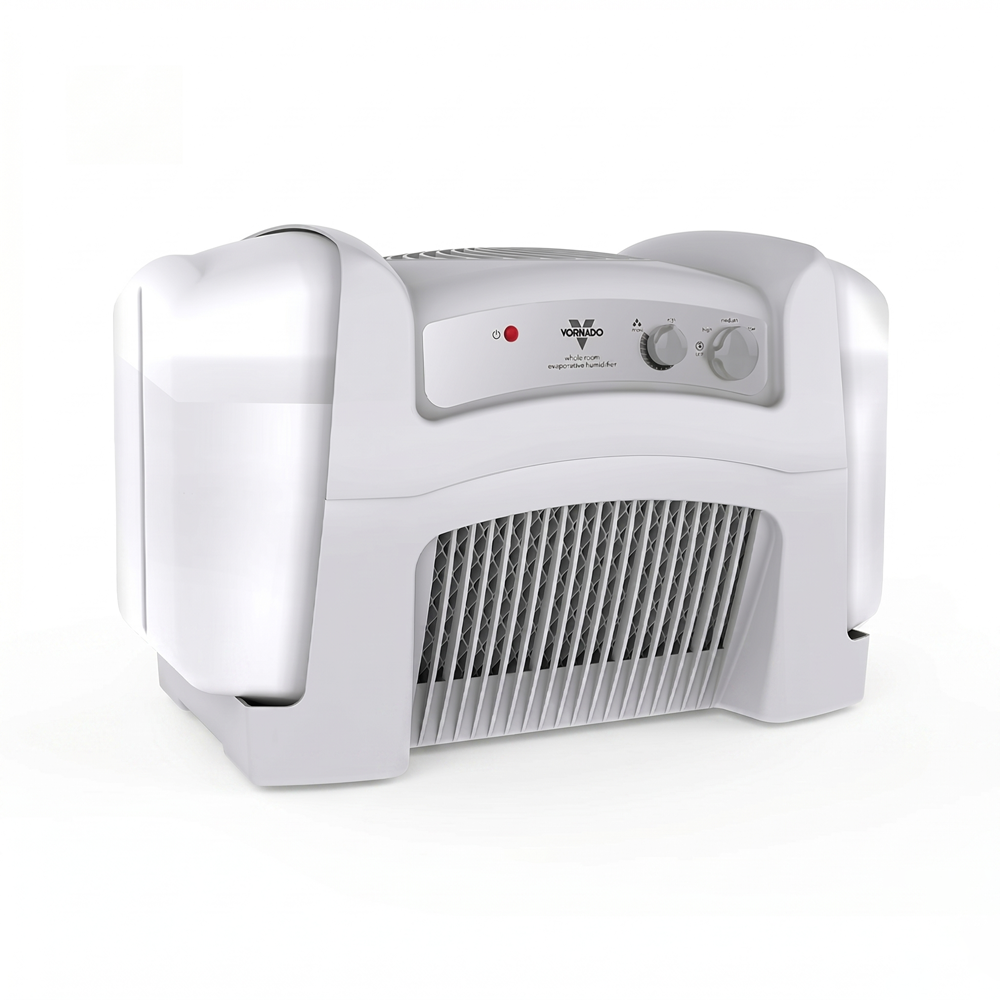
The Quick Pick: To avoid the “white dust” and sensor conflict, always choose an evaporative model. Vornado Evap40 4-Gallon Evaporative Humidifier (Check Price on Amazon)
| Performance & Accuracy | 22/25 |
| Reliability & Durability | 21/25 |
| Ease of Use & Cleaning | 18/20 |
| Design & Safety | 14/15 |
| Price-to-Performance | 14/15 |
| Value Index | 89/100 |
Why we picked it: It’s an engineering brute. It uses massive wicks and Vornado’s signature vortex circulation for pure, invisible evaporation for up to 1,000 sq. ft. Zero mist, zero dust, and zero conflict with your air purifier.
Still debating between Mist and Vapor? Need to calculate the exact tank size for a nursery, or worried about “Pink Mold” risks? Don’t guess. Read our full engineering guide: Ultrasonic vs. Evaporative: Which is Safer?
3.The Air Purifier: The “Solid Matter” Trap
Let’s clear up a misconception: An Air Purifier does not care about water. It is a sieve. It traps solids (dust, pollen, smoke). It cannot “drink” humidity, and it cannot “add” moisture.
The Reality Check: Dead Zones in Large Rooms
In fluid dynamics, Airflow (CFM) is king. A purifier can only clean the air that physically gets to it. It creates a small “bubble” of clean air around itself, while distant corners of the room remain stagnant dead zones. A tiny purifier in a big room is like trying to empty a swimming pool with a straw.
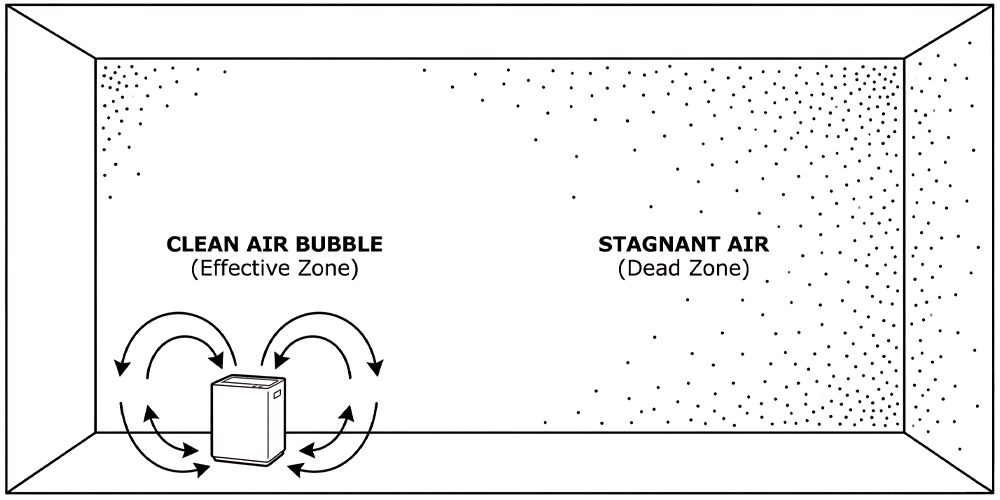
The $20 Fix: Using a Fan to Boost Airflow
Don’t just buy a bigger purifier; buy a cheap Air Circulator Fan.
How to place it: Point the fan away from the purifier. This forces the air in the room to mix, pushing the stagnant, dirty air out of the dead zones and towards the purifier’s intake. This simple trick can double your purifier’s effective coverage area without spending extra on a “Pro” model.
Our Recommendation
The Quick Pick: For most bedrooms and medium living spaces, you need a balance of power and filtration. LEVOIT Core 300-P Air Purifier for Home Allergies (Check Price on Amazon)
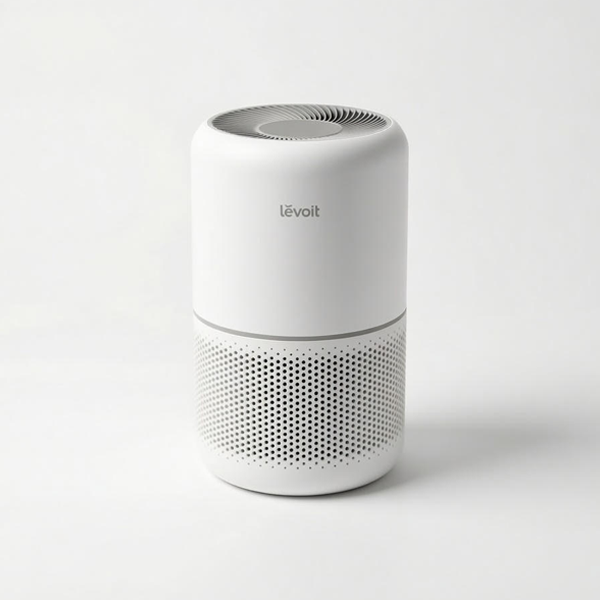
| Performance & Accuracy | 23/25 |
| Reliability & Durability | 22/25 |
| Ease of Use & Cleaning | 18/20 |
| Design & Safety | 13/15 |
| Price-to-Performance | 14/15 |
| Value Index | 90/100 |
Why we picked it: A proven workhorse covering up to 1,073 sq. ft. It features a medical-grade H13 True HEPA filter and high-torque motor for consistent performance.
This unit is a workhorse, but our lab tests revealed one specific trade-off regarding its “Sleep Mode” performance. Before you buy, read the full verdict in our engineering guide:The Engineer’s Guide: Best Air Purifiers
When You Need More Than One Device (The Synergies)
Sometimes, one machine isn’t enough to fix the physics of your room. But you can’t just plug them all in randomly. Here is how to combine them effectively.
Combo 1: The “Mold Defense” (Dehumidifier + Air Purifier)
Best for: Basements, Bathrooms, and High Humidity Areas.
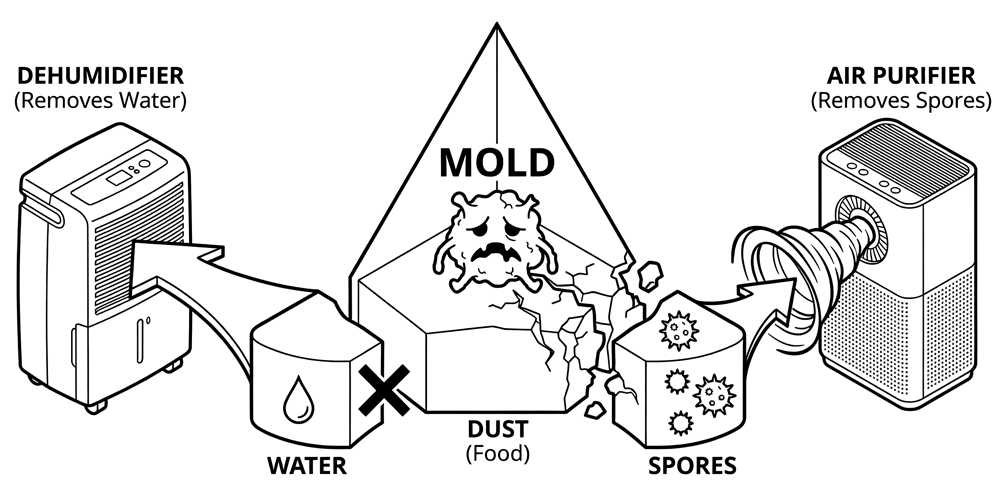
If you are fighting mold, buying just one machine is often a losing battle. Using them together is the ultimate weapon because it breaks the “Mold Triangle” from two sides:
- Step 1: Cut off the Water Source (Dehumidifier): It drops the humidity below 50%, cutting off the mold’s water source. The mold stops growing and goes dormant.
- Step 2: Capture Airborne Spores (Air Purifier): While the mold is drying out, the purifier captures the airborne spores (seeds) before they can land on damp surfaces and start a new colony.
Result: You aren’t just cleaning the air; you are creating an environment where mold can’t survive.
Combo 2: The “Winter Comfort” (Humidifier + Air Purifier)
Best for: Bedrooms in Winter (Cold & Dry).
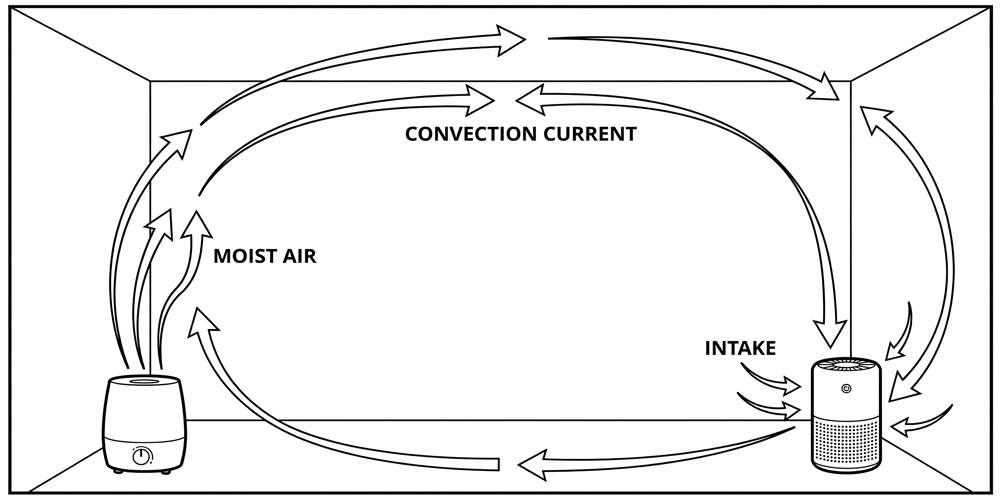
In winter, windows are closed (trapping dust) and heaters are on (drying the air). You need both machines, but they often fight each other.
The Rule: You MUST use an Evaporative Humidifier (the kind with a filter wick), not an Ultrasonic one.
The Placement Physics: Do not place them right next to each other.
- Why: If the Air Purifier sucks in the moist air immediately, the filter can get damp and become a breeding ground for bacteria.
- Fix: Place them across the room from each other to create a Convection Current—one machine pushes moisture out, the other pulls particles in, cycling the whole room effectively.
The Verdict: How to Choose
- This decision framework is part of our complete home safety and air quality strategy — covering every device and every room.+
- Enemy is Water → Dehumidifier
Don’t ask “Which one should I buy?” Ask “What is my enemy?”
- Enemy is Water? Dehumidifier (but watch the heat).
- Enemy is Dryness? Humidifier (Evaporative only!).
- Enemy is Particles? Air Purifier.
- Enemy is Mold? You need the Siege Combo (Dehumidifier + Purifier).
Once you know the enemy, the machine is just a tool—not a guess.
See our complete Home Safety & Air Quality strategy
FAQ
What is the ideal indoor humidity level for health and comfort?
The “Goldilocks Zone” for both human health and home structure is typically between 40% and 60% relative humidity. Below 30%, viruses may spread faster, wood furniture cracks, and skin becomes dry and itchy. Above 60%, dust mites thrive, mold growth becomes likely, and the air feels heavy and uncomfortable.
Are 2-in-1 humidifier and air purifier combos worth it?
Generally, no. We strongly advise against them from an engineering standpoint due to a fundamental design flaw: the inability to separate the two functions. Effective placement requires separating a humidifier from a purifier to create room-wide circulation. In a combo unit, the intake and output are inches apart, forcing the purifier to suck in the humid air directly from the humidifier. This guarantees two problems: 1) It causes “short-cycling,” where the machine thinks the room is humid when it is not. 2) The damp air inevitably saturates the HEPA filter, turning it into a breeding ground for mold and bacteria. It is safer and more effective to buy two separate machines and place them apart.
Are ongoing maintenance costs high for these devices?
Yes, you must factor in long-term costs, not just the purchase price. For dehumidifiers, the main cost is electricity. Their compressors use significant power, similar to a small AC unit. For air purifiers and evaporative humidifiers, the main cost is filter replacements. HEPA filters and humidifier wicks must be replaced every 3-6 months to remain effective and sanitary. Budget accordingly.
Does a humidifier make a room damp or cause mold?
Yes, if used incorrectly. Its sole job is to add moisture. The mistake is running a humidifier when your room’s humidity is already above 50%. This will quickly push the room into the “mold danger zone.” The rule is to only use a humidifier when the air is actively dry (typically below 35-40% relative humidity).
Where is the worst place to put these machines?
Right against a wall or behind furniture. The physics reason is that all these machines rely on airflow. They need to suck air in and blow it out freely. Placing them flush against a wall chokes their intake or exhaust, drastically reducing their efficiency and potentially causing them to overheat. The fix is to always leave at least 12-18 inches (30-45 cm) of clearance on all sides.
Related Articles
Home Safety & Air Quality: The Complete Guide (2026)
How to Choose a Dehumidifier (2026)
Ultrasonic vs Evaporative Humidifiers Guide (2026)
Best Air Purifier for Allergies, Mold & VOCs (2026)
Meet the Team
DontPickIt Home Lab
“Your home is a complex ecosystem. We analyze everything that plugs in, turns on, or helps you relax. From mastering your indoor climate to automating your kitchen and cleaning routines, we test products against dust, hard water, and daily chaos. Our goal: finding tools that solve problems without creating new ones.”