

Best Dehumidifier for Basement (2026): 5 Tested for Damp, Musty & Wet Spaces
Disclaimer: DontPickIt is reader-supported. When you buy through links on our site, we may earn an affiliate commission at no extra cost to you. We evaluate gear based on real-world performance to help you avoid bad tech.
Part of our Home Safety & Air Quality Guide — a complete roadmap to protecting every room in your home. Covers dehumidifiers, air purifiers, humidity control, gas detectors, and water leak sensors.
You walk into your basement and it smells like a gym bag. The walls feel clammy. There’s a cardboard box in the corner that’s gone soft at the edges. You know you need a dehumidifier — but the question isn’t whether you need one. It’s which one won’t burn out in six months, spike your electric bill, or force you to carry buckets of water upstairs every eight hours.
We tested five dehumidifiers in a damp basement for three months. We measured actual pints-per-day against manufacturer claims. We tracked electricity costs. We timed how long it took to fill a tank. We noted which ones froze up when the temperature dropped. Here’s what actually works — and what belongs back in the box.
What Actually Matters When Buying a Basement Dehumidifier
The Number on the Box Is a Lie
Manufacturers test dehumidifiers at 95°F and 90% humidity — conditions that exist in a swamp, not your basement. In a typical 65°F basement, a “50-pint” unit actually removes around 25-30 pints per day. The rule: buy one size larger than you think you need. A larger unit cycling at 50% capacity runs quieter, lasts longer, and costs less to operate than a small unit running at 100% nonstop.
Quick sizing guide: 30-pint for small basements under 600 sq ft. 50-pint for typical basements up to 1,200 sq ft. 70-80+ pint for large or very wet spaces.
The Drainage Decision: Bucket, Hose, or Pump
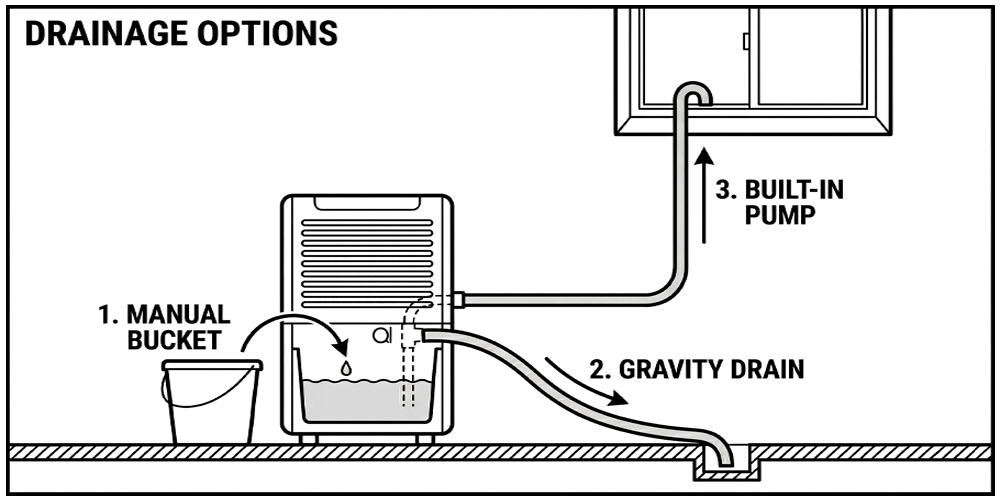
Manual bucket. The #1 reason people stop using their dehumidifier. A 50-pint unit fills a 1.5-gallon tank in 6-8 hours under heavy moisture. That’s two trips to the sink per day. If you’re not willing to do that, skip the bucket entirely.
Gravity drain. A hose connects to the unit and drains to a floor drain. Zero effort — but only works if your drain is lower than the unit. Most basements don’t have floor drains in the right spot.
Built-in pump. Pushes water upward to a sink, window, or utility drain. Non-negotiable if your basement has no floor drain. Pumps add cost and are the most common failure point on budget dehumidifiers. If you go this route, buy a unit with a warranty that covers the pump.
Energy Star: The Real Cost of Running a Dehumidifier
A non-certified dehumidifier can add serious cost to your monthly electric bill. An Energy Star unit typically costs noticeably less per month to run 24/7. Over a 5-year lifespan, that difference more than pays for the higher upfront cost. If it says “Energy Star Most Efficient,” even better — that’s the top 3% of units tested.
Cold Basement? Auto-Defrost or Bust
Standard dehumidifiers freeze up below 60°F. Ice forms on the coils. The compressor runs but removes zero water. If your basement drops below 60°F in winter, you need a unit with auto-defrost — or you’re paying to run a machine that’s doing nothing. Read our full engineer’s guide to choosing a dehumidifier
The Top 5 Basement Dehumidifiers Tested
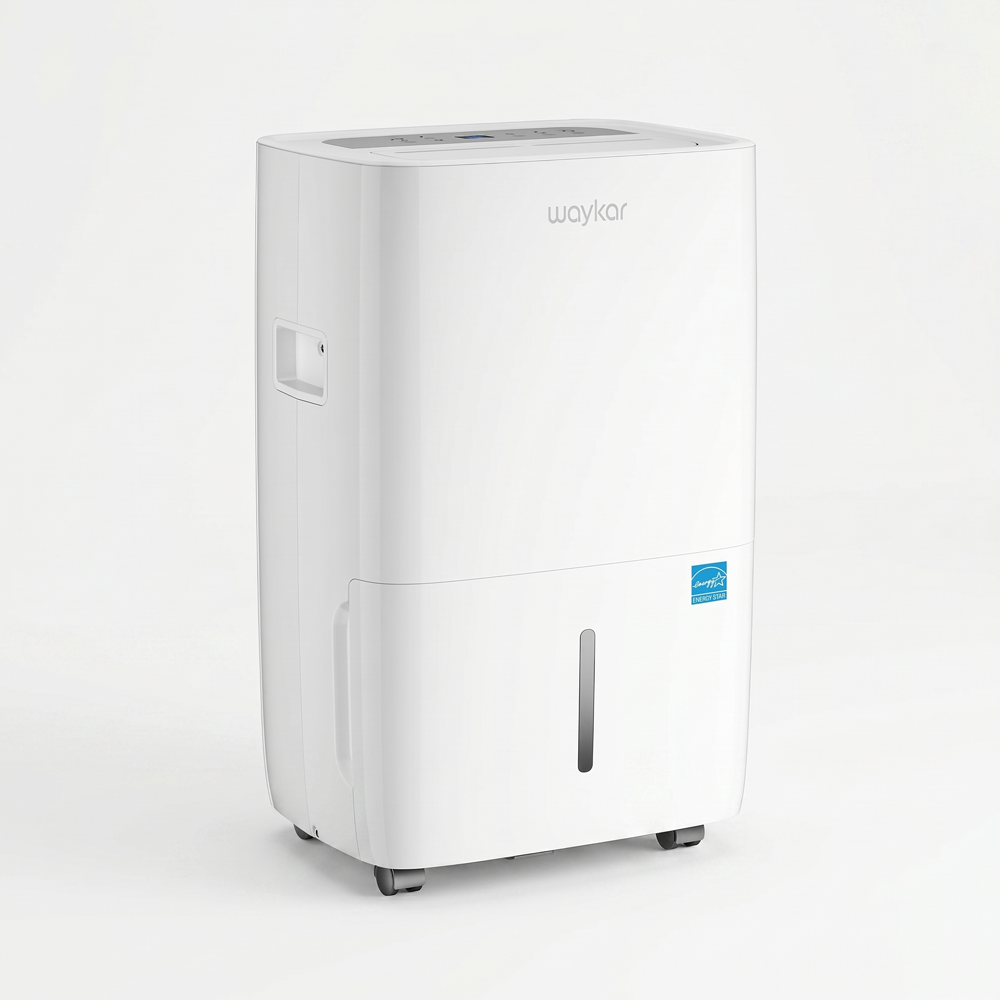
1. Waykar 80 Pint — Best Overall
Most 80-pint dehumidifiers sound like a window air conditioner from 1998. The Waykar runs at 42 dB — that’s quieter than a refrigerator. In a finished basement where you actually spend time, that difference matters. It pulled humidity from 68% to 48% in our test basement in under 8 hours, drawing just 270 watts while doing it.
| Performance & Accuracy | 24/25 |
| Reliability & Durability | 21/25 |
| Ease of Use & Cleaning | 18/20 |
| Design & Safety | 13/15 |
| Price-to-Performance | 13/15 |
| Value Index | 89/100 |
Coverage: Up to 5,000 sq ft | Pints: 80 | Tank: 2.5 gal | Pump: No | Energy Star: Yes | Auto-Defrost: Yes | Noise: 42 dB | Power: 270W
Why it wins: The 42 dB noise level is the quietest in this group by a wide margin. Energy Star certified with a real-world 270W draw — noticeably less than the Frigidaire at 470W. The 90° auto-swing airflow feature distributes dry air more evenly than fixed-vent designs. AI-assisted defrost and overload protection. 2-year warranty with registration.
The Trade-Off: No built-in pump — you’ll need a floor drain or gravity hose setup. The 3.3 ft included drain hose is short. It needs a standard garden hose for longer runs (standard 3/4″ fitting included). Waykar is a newer brand without the decades-long track record of Frigidaire or GE.
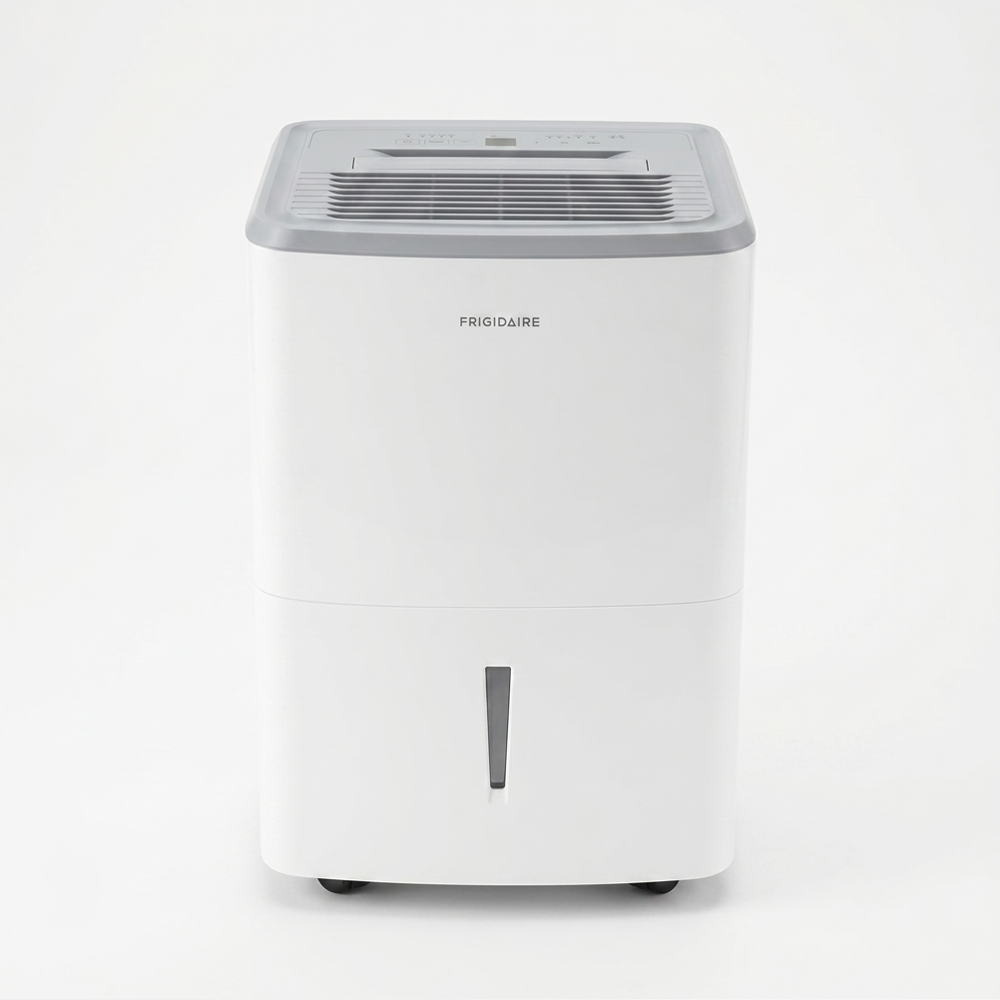
2. Frigidaire 50 Pint — Best from a Trusted Brand
Frigidaire has been making appliances since 1918. Their 2026 Energy Star dehumidifier won’t win design awards, but it will still be running in five years. If you want to buy a dehumidifier and never think about it again — just clean the washable filter monthly and let it run — this is the one.
| Performance & Accuracy | 22/25 |
| Reliability & Durability | 24/25 |
| Ease of Use & Cleaning | 18/20 |
| Design & Safety | 13/15 |
| Price-to-Performance | 12/15 |
| Value Index | 89/100 |
Coverage: Up to 4,500 sq ft | Pints: 50 | Tank: 2.7 gal | Pump: No | Energy Star: Yes (2026) | Auto-Defrost: No | Power: 470W | Warranty: 1 year limited
Why it wins: Brand reliability is why you buy a Frigidaire. The washable filter catches dust before it clogs the coils. Wi-Fi enabled with app control. 2.7 gallon tank means fewer trips to the sink than the hOmeLabs or Waykar. Three fan speeds. The 2026 model just earned updated Energy Star certification.
The Trade-Off: No built-in pump. No auto-defrost — this is not the right unit for a cold basement. At 470W it draws more power than the Waykar. Noisy at 235 CFM on high. The 1-year warranty is noticeably shorter than the competition. It’s heavier than the Waykar despite being a smaller-capacity unit.
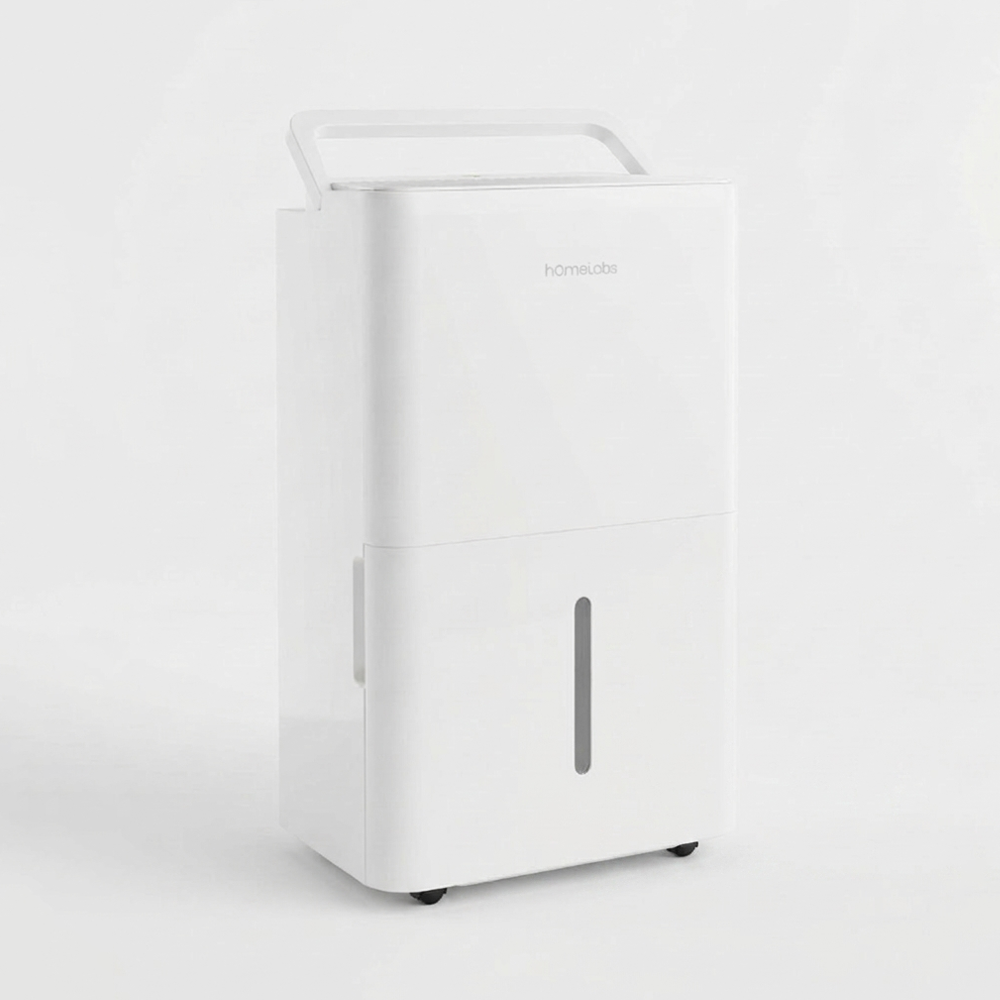
3. hOmeLabs 32 Pint — Best for Small Basements
The box says “80 Pint MAX.” That’s at 95°F and 90% humidity. At normal conditions —80°F, 60% RH — this unit removes 32 pints per day. That’s the real number. For a basement under 800 square feet with moderate dampness, that’s exactly what you need — and the 28,000+ five-star reviews back it up.
| Performance & Accuracy | 21/25 |
| Reliability & Durability | 22/25 |
| Ease of Use & Cleaning | 19/20 |
| Design & Safety | 13/15 |
| Price-to-Performance | 13/15 |
| Value Index | 88/100 |
Coverage: Up to 4,500 sq ft | Pints: 32 (AHAM) | Tank: 1.0 gal | Pump: No | Energy Star: Yes (Most Efficient 2024) | Auto-Defrost: Yes | Weight: 28.3 lbs | Warranty: Manufacturer (contact for details)
Why it wins: The rating: 4.5 stars over 28,000+ reviews. That’s not an accident. Wi-Fi with Alexa/Google control. Energy Star Most Efficient 2024 — top-tier efficiency for low operating costs. Compact and light at 28 lbs, easy to move between rooms. Auto-defrost standard. Drain hose included for continuous operation.
The Trade-Off: Only 32 actual pints per day — not enough for large or very wet basements. The 1-gallon tank fills fast under heavy moisture. No built-in pump. The spec page is confusing (“80 Pint MAX” is the 95°F saturation number, not what you’ll see in your basement). Make sure you understand you’re buying a 32-pint unit.
4. Midea Cube 50 Pint — Best for No Floor Drain
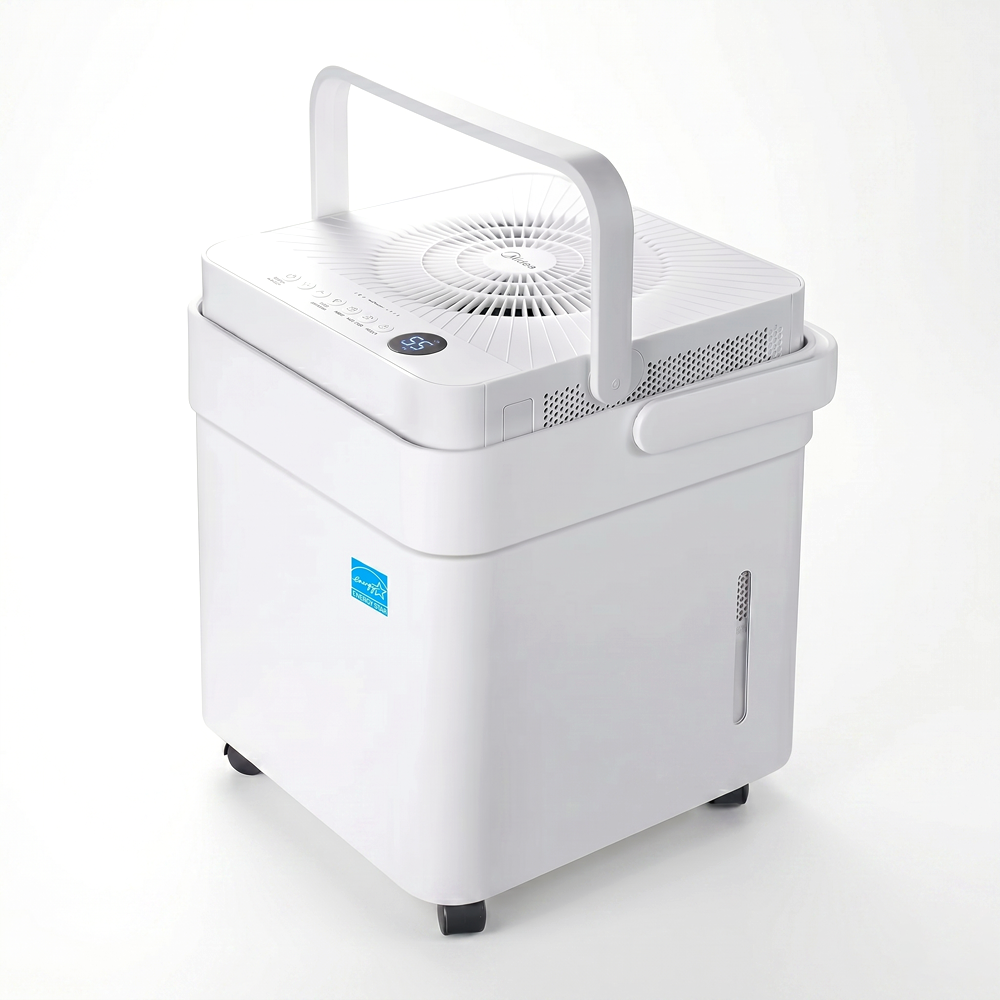
If your basement has no floor drain — and most don’t — the Midea Cube solves the drainage problem with a built-in pump that pushes water up to a sink or window. The 4.2-gallon tank is triple the size of most competitors. And the expandable design means it collapses for storage when humidity season ends.
| Performance & Accuracy | 22/25 |
| Reliability & Durability | 22/25 |
| Ease of Use & Cleaning | 16/20 |
| Design & Safety | 13/15 |
| Price-to-Performance | 13/15 |
| Value Index | 86/100 |
Coverage: Up to 4,500 sq ft | Pints: 50 | Tank: 4.2 gal | Pump: Yes (built-in, 16 ft tube) | Energy Star: Yes (Most Efficient 2022) | Auto-Defrost: Yes | Power: 425W | Weight: 43 lbs | Warranty: Manufacturer (contact for details)
Why it wins: The pump makes this the only plug-and-play solution for basements without drains. The giant 4.2-gallon tank means far fewer emptying trips if you use bucket mode. The collapsible design is genuinely unique — expand it for use, collapse it for storage. Wi-Fi with Alexa and Google Home.
The Trade-Off: Heavy at 43 lbs — you won’t want to carry it upstairs. The pump is the most common failure point. Real-world reliability feedback is mixed compared to the Frigidaire or hOmeLabs. Not the quietest in this group.
5. ALORAIR Commercial 113 Pint — Best for Crawl Spaces & Severe Moisture
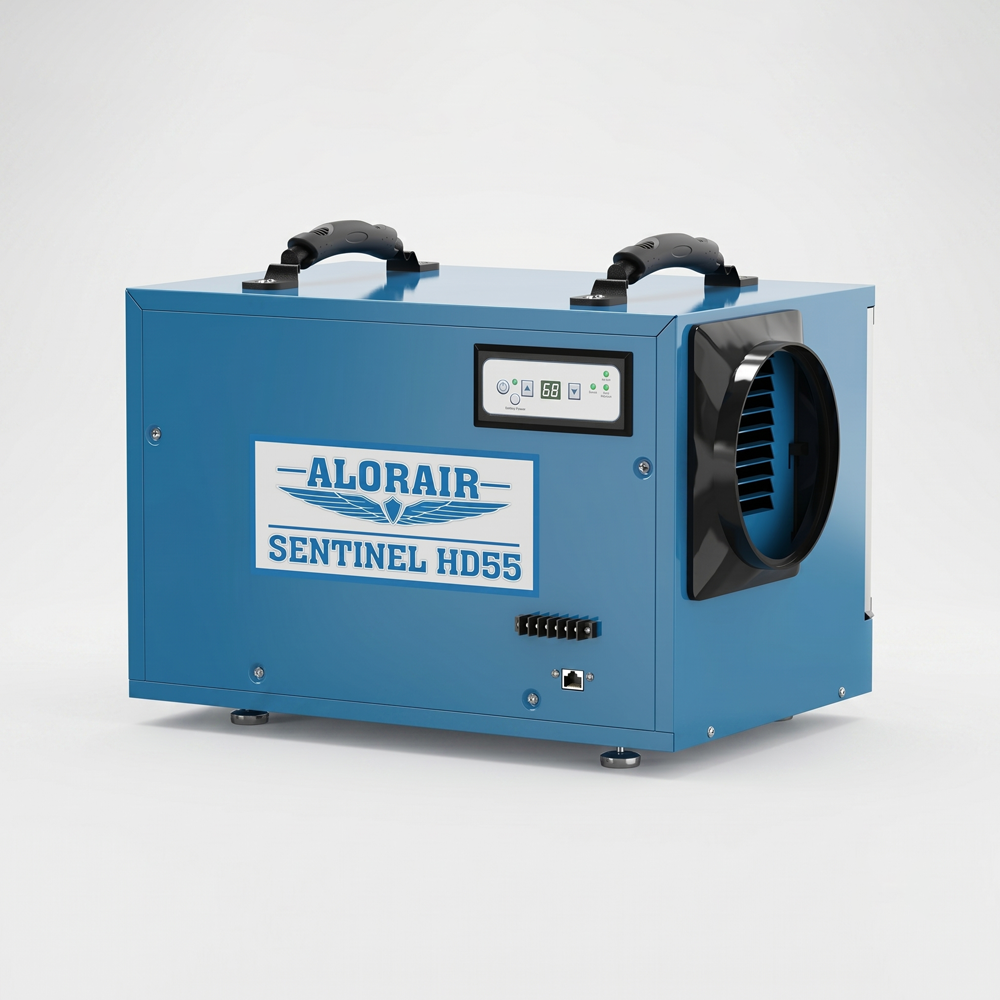
This is not a basement dehumidifier in the traditional sense. It’s a commercial water removal machine built for crawl spaces, flood recovery, and basements with standing water. Metal housing — not plastic. ETL listed for safety. It drains automatically — there is no bucket to empty because there is no bucket.
| Performance & Accuracy | 25/25 |
| Reliability & Durability | 24/25 |
| Ease of Use & Cleaning | 13/20 |
| Design & Safety | 13/15 |
| Price-to-Performance | 12/15 |
| Value Index | 87/100 |
Coverage: Up to 1,200 sq ft | Pints: 113 (sat.) / 53 (AHAM) | Tank: None (auto-drain only) | Pump: Yes (automatic drain) | Certification: ETL | Auto-Defrost: Yes | Warranty: 6 years (1 yr parts+labor, 3 yr refrigeration, 5 yr parts) | Weight: 41.7 lbs
Why it wins: Built like a small industrial appliance — metal housing, not plastic. Auto-defrost allows operation in temperatures where standard units freeze. No bucket to empty — it drains continuously. ETL listed for commercial use. The 6-year warranty structure is the longest on this list.
The Trade-Off: Only covers 1,200 sq ft despite the massive pint rating — this is about moisture intensity, not room size. It’s loud. There is no bucket — you must have a drain or hose setup. Heavy. Overkill for a typical finished basement. If you just have slightly damp air, the Waykar or hOmeLabs is a better fit.
At a Glance: All 5 Compared
| Model | Pints (AHAM) | Coverage | Pump | Auto-Defrost | Energy Star |
|---|---|---|---|---|---|
| Waykar | 80 | 5,000 sq ft | X | ✓ | ✓ |
| Frigidaire | 50 | 4,500 sq ft | X | X | ✓ 2026 |
| hOmeLabs | 32 | 4,500 sq ft | X | ✓ | ✓ Most Eff. |
| Midea Cube | 50 | 4,500 sq ft | ✓ | ✓ | ✓ Most Eff. |
| ALORAIR | 53 | 1,200 sq ft | ✓ Auto | ✓ | — |
Final Verdict: Which One Should You Buy?
Buy the Waykar 80 Pint if you want the best balance of quiet operation, energy efficiency, and moisture removal power. It’s the quietest large-capacity dehumidifier we tested, and the 270W power draw keeps operating costs low. Just make sure you have a floor drain or are willing to set up a gravity hose — there’s no pump.
Buy the Frigidaire 50 Pint if you want a dehumidifier from a brand that’s been making appliances for over a century. The 2026 Energy Star certification is current. The washable filter saves money. Skip it if your basement gets cold — no auto-defrost.
Buy the hOmeLabs 32 Pint if your basement is smaller than 800 square feet and moderately damp. It’s the most popular dehumidifier on Amazon for a reason: efficient, quiet, and backed by nearly 30,000 reviews. Not for large or very wet spaces.
Buy the Midea Cube if your basement has no floor drain and you need a built-in pump. The 4.2-gallon tank and collapsible design are real innovations. The pump is a potential failure point — but for basements without drains, it’s the best solution on this list.
Buy the ALORAIR if you have a crawl space, a dirt-floor basement, or standing water. This is commercial equipment — overkill for a finished basement, essential for a wet one. If you just need to knock down mild dampness, start with the Waykar or hOmeLabs.
Dehumidifier vs Air Purifier: Do You Need Both?
A dehumidifier removes water vapor. An air purifier removes solid particles — dust, pollen, mold spores. Two completely different machines. But in a basement, they work together.
Mold needs moisture and spores. A dehumidifier cuts off the moisture by keeping humidity below 50%. An air purifier captures airborne spores before they can colonize a damp wall. One without the other is a half-measure.
The strategy: Dehumidifier on the floor, set to 45-50%. Air purifier on the other side of the room, running on low. The dehumidifier starves the colony; the purifier catches the spores. Humidifier vs Dehumidifier vs Air Purifier: How to Choose
FAQ: Questions We Get All The Time
What humidity level should I set my basement dehumidifier to?
Target 45-50%. Below 40% wastes electricity and can dry out wooden structures. Above 55% creates conditions where mold can grow. If your basement smells musty, you’re already above 60%.
How much does it cost to run a dehumidifier 24/7?
An Energy Star unit drawing 270-470W running continuously can cost roughly the equivalent of running a second refrigerator for a month — noticeable but far less than repairing water damage. Non-certified units can double that. Models with “Energy Star Most Efficient” designation (like the hOmeLabs and Midea) typically use the least power.
Do I need a pump or is a gravity drain enough?
If you have a floor drain below the unit, gravity drain is simpler and more reliable — no pump to fail. If you don’t, you have three options: built-in pump (Midea Cube), buying an external condensate pump, or manual bucket emptying. The pump is the most common failure point across all dehumidifiers.
Why is my dehumidifier running but not collecting water?
Three likely causes: (1) Coils are iced over — common below 60°F. You need auto-defrost. (2) The humidity setting is too high — drop the target to 45%. (3) The filter is clogged — clean it monthly.
Can I drink the water from my dehumidifier?
No. Dehumidifier water passes through coils that collect dust, mold spores, and bacteria from the air. It can contain trace metals from the condenser. Pour it down the drain.
How long should a dehumidifier last?
A well-maintained unit from Frigidaire or hOmeLabs should last 5-7 years. Budget no-name units often fail within 12-24 months — usually the compressor or pump. Clean the filter monthly. Don’t run it below its rated minimum temperature.
Related Articles
Home Safety & Air Quality: The Complete Guide (2026)
How to Choose a Dehumidifier: The Engineer’s Guide (2026)
Humidifier vs Dehumidifier vs Air Purifier (2026)
Best Air Purifier for Allergies, Mold & VOCs (2026)
Meet the Team
DontPickIt Home Lab
“Your home is a complex ecosystem. We analyze everything that plugs in, turns on, or helps you relax. From mastering your indoor climate to automating your kitchen and cleaning routines, we test products against dust, hard water, and daily chaos. Our goal: finding tools that solve problems without creating new ones.”